

Keywords are not just random words or phrases used in your content.
They vary based on different factors, such as their goals, roles, or structure. And exploring these differences will give you clearer insights into how to build your content strategy.
Read along to uncover the most common types of keywords in SEO with examples, as well as how to find each of them.
What Are Keywords? Their Importance in SEO
Keywords are words or phrases users type in Google or other search engines to find answers or information. Those can be anything from one-word keywords to long phrases or questions.
Thus, properly optimizing your content with relevant keywords helps search engines determine:
- Whether it matches users’ search queries
- Whether it deserves to appear as a relevant answer source in search results.
This is where understanding different types of keywords comes into play, as they are an important part of the SEO keyword mapping and keyword optimization process.
The Main Types of Keywords: Grouped and Explained
Now that the importance of learning about the keyword types is clear, let’s see what the main types of keywords are.
To make it more structured and clearer, we have grouped the types by their goals and meanings.
-
Intent-Based Keywords
These keywords reflect the user’s search intent (the purpose or reasoning behind a search query).
There are four types of intent-based keywords:
Informational: Users want to get some information (for example: why is SEO important?)
Navigational: They want to land on a specific website or platform (for example: Instagram login)
Commercial: Users are still in the research phase before making a purchase (for example: best SEO tools review)
Transactional: They are ready to make a purchase (for example: subscribe to Netflix)
As you may have noticed, each type of keyword often includes specific words that signal the category it belongs to.
- Informational: “What?”, “Why?”
- Navigational: “login”, “sign in”
- Commercial: “best”, “top”, “review”
- Transactional: “buy”, “purchase”
To quickly identify keyword intent, consider using SEO tools. They are designed to browse dozens of keywords with their intents in seconds, so that you don’t have to check them manually.
In the example below, Ahrefs, one of such tools, has a special column for showing the intent right next to each keyword.
- First, log in to your Ahrefs account
- Go to the “Keywords Explorer” section and type your keyword.
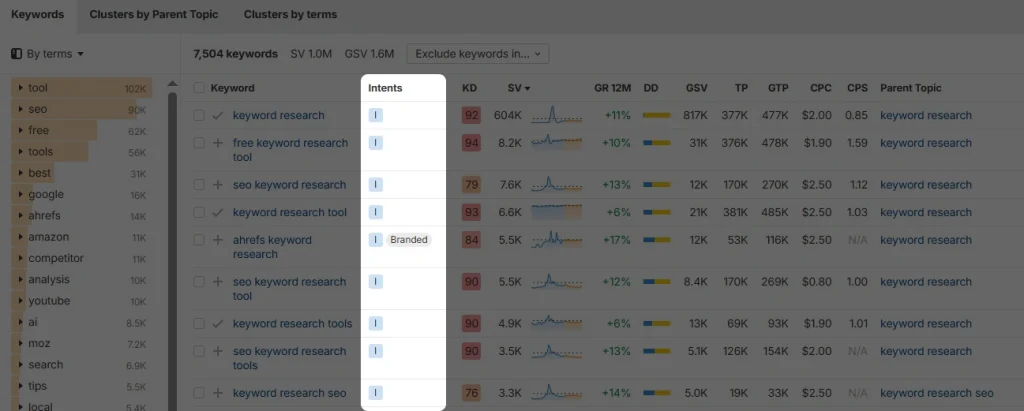
In the “Terms match” section, you will find the relevant intent letter (I, N, C, T) next to each of the suggested keywords. You can also identify which of the keywords are branded.
-
Structure-Based Keywords
There are two types of keywords based on their structure, search volume, and competitiveness: long-tail and short-tail.
- Short-tail: Short-tail keywords are keywords consisting of up to 3 words (for example: keyword research). They are broad and have high keyword search volumes. Therefore, they are also highly competitive as they are targeted more.
- Long-tail: The name tells for itself. These are the longer versions of keywords, usually including 4 or more words (for example: keyword research tools for small businesses). They are more specific and therefore have lower search volume than short-tail ones.
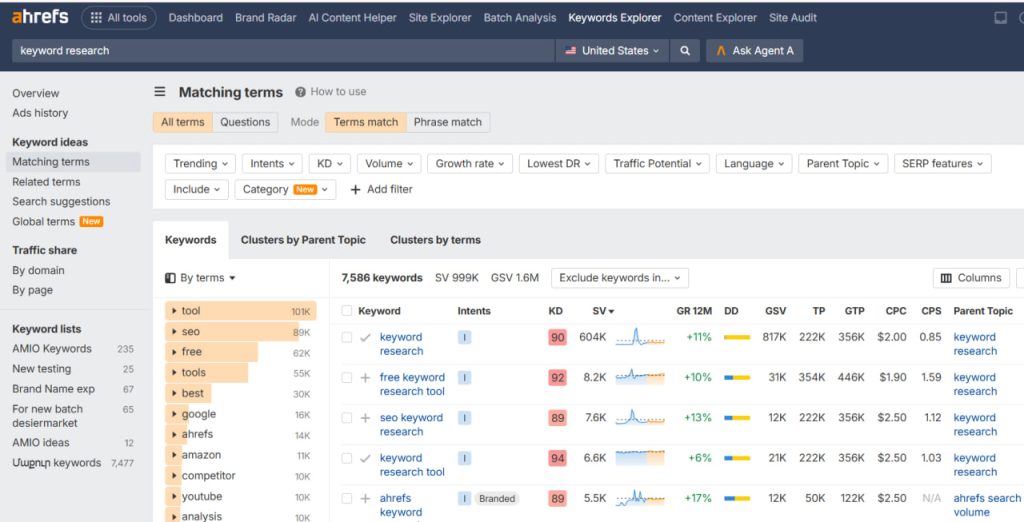
To identify short-tail and long-tail keywords on Ahrefs, you can simply see which of the keywords in “Terms match” have up to 4 or more.
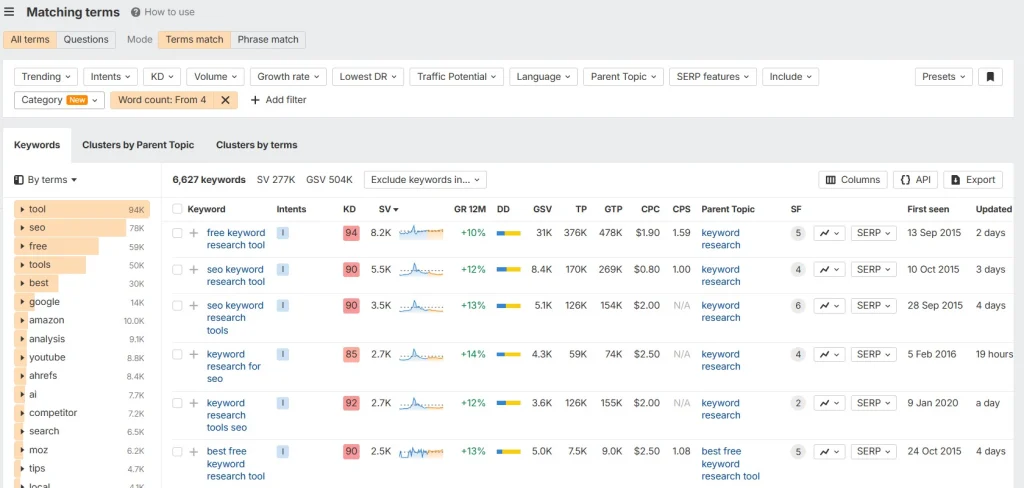
Pro tip: To find long-tail keywords faster, add the “Word count” filter starting from 4 words.
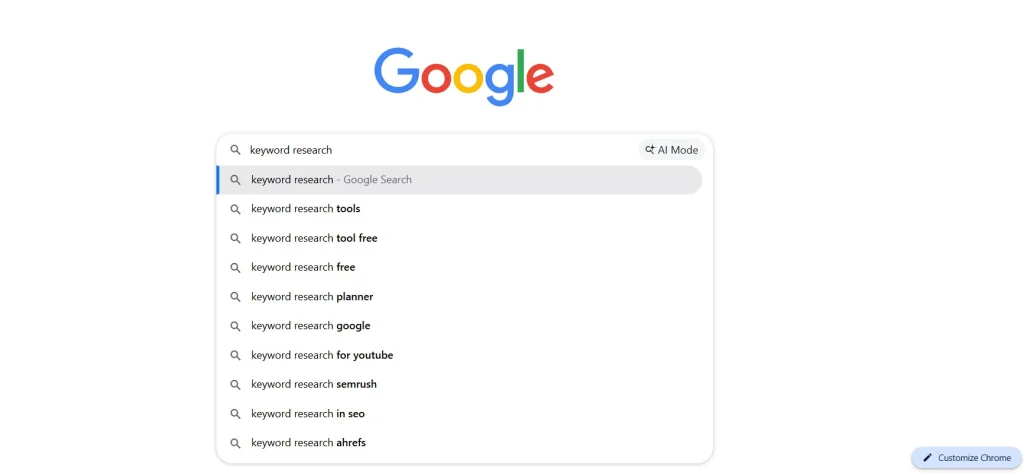
Google’s autocomplete feature can also help you find both short-tail and long-tail keywords. Just go to the Google search bar and type your search keyword or focus keyword to see what results appear below.
It is worth noting that there is no strict rule for which one of these keywords is the best for your SEO strategy. Using the best SEO tool can help you evaluate both options based on your goals, website potential, and resources.
-
Role-Based Keywords
We named this group “target-based” because the keywords in this group differ in their target goals and why they are used in content strategies.
- Seed keyword: The seed keyword is the initial keyword you use to start your keyword research. It is broad, general, and usually consists of one or two words.
- Focus keyword: The focus keyword (also known as the primary keyword) is the main keyword you want your content to target and rank for. It serves as the central topic around which your content is built.
- Secondary keyword: These are supporting keywords related to your focus keyword. They also have ranking potential, and using them naturally and relevantly throughout your content can strengthen your SEO writing efforts and improve your chances of ranking for multiple search queries.
Again, each of these keywords can be used for different purposes and in different ways.
If it is a seed keyword, it is mainly used at the very beginning of your keyword research stage. It helps you find more keywords that have a ranking potential and can be used in your content. They also help you understand your content direction and strategy.
Meanwhile, your focus keyword should strategically be placed in headings, meta tags, the introduction, and the conclusion of your article. This is important for signaling search engines on what you are targeting in your content. But beware of keyword stuffing.
And finally, secondary keywords can be simply placed in different sections of your article based on relevance.
Why is it Important to Master the Types of Keywords?
At first, it might seem like learning all the different keyword types will not make much difference when building your SEO strategy.
In reality, understanding how keywords work and what purpose each type serves can help you create more targeted and effective content.
Using the right keywords allows you to connect with the right audience at the right stage of their search journey, which can improve both rankings and conversions:
- Right targeting: Different keywords attract different audiences. So, using the right type of keyword will help you reach users with the right intent and provide content that matches their needs.
- Defining your strategy: Understanding keyword types makes it easier to plan your content strategy and prioritize SEO efforts.
In addition, mastering keyword types can:
- Strengthen your chances of ranking higher in search engines
- Help you compete more effectively in your industry.
A well-structured keyword strategy also prevents you from targeting the wrong audience or creating content that fails to meet user expectations.
To Wrap Up
Keywords play a major role in building an effective content strategy.
Understanding the different types of keywords gives you an even greater advantage when it comes to targeting the right audience.
By choosing keywords based on search intent, you can create content that better matches what users are actually looking for at every stage of their online journey.
To get the best results, do your keyword research, analyze search intent carefully, and build your content around the most relevant keyword types.
This approach will help your content appear in front of the right audience at the right time, increasing your chances of driving meaningful traffic, engagement, and conversions for your brand.