
Let’s picture this: you spent hours researching your topic and writing a top-notch article. You feel relaxed after finally publishing it. But time passes, and your article is not doing so great on SERPs.
So you start questioning whether your piece was good enough. The thing is that the problem may not be in the content itself, but the SEO strategies that you might have missed while writing your article.
To do well on SERPs, you need to master the SEO writing tips and tricks.
And this article provides just that, so read along to find out more.
What is SEO Writing?
SEO writing is the process of writing and optimizing your content so that it ranks well on search engines and attracts traffic. It also helps your content get featured on AI search engines, too. Various optimization rules are used to achieve this goal.
This is what makes it different from general content writing.
- SEO writing: Here, your content is strategically structured around keywords and search intent. It follows a clear optimization structure. The core goal is to improve visibility on search engines while maintaining readability and value for the reader.
- Content writing: The focus is primarily on informing, educating, or engaging the audience. It is more flexible in structure and does not require strict keyword targeting. As a bonus, it can still perform well in search results if the content naturally matches the search intent.
So, remember that your article should not only answer people’s queries but also be structured in an SEO friendly way.
SEO Writing: A Go-To Optimization Checklist
So, if your goal is to increase your brand visibility through your content, let’s turn to the optimization steps below.
Optimize Your Article Structure
One of the most important rules in SEO writing is your article structure. It has to be as clear as possible to ensure readability.
Here are some common points you need to consider when structuring your article:
- Keep your meta titles within 50-60 characters, while meta descriptions within 150-160 characters.
- Ensure a hook in your meta tags, so that your readers are interested enough to click and open your article.
- URL slug: Optimize your article URL, too, by making it as short and clear as possible. For example: /seo-writing, /content-writing-tip.
- Bullet points and numberings: Where relevant, break your idea into bullet points and numberings as these are easier to read visually than long paragraphs, which readers usually tend to skip.
- Clear paragraphs and sections: Break your articles into paragraphs. Try to present one idea per paragraph without stuffing them. Be short and precise.
By ensuring your article is structured, not only people, but also search engines will be able to smoothly scan through your article and grasp which topic is mentioned in which section.
Identify the Search Intent
Search intent is the reason behind your users’ searches. Why did they search for that specific term, and what information did they want to get? And to rank higher, your content should match their intent.
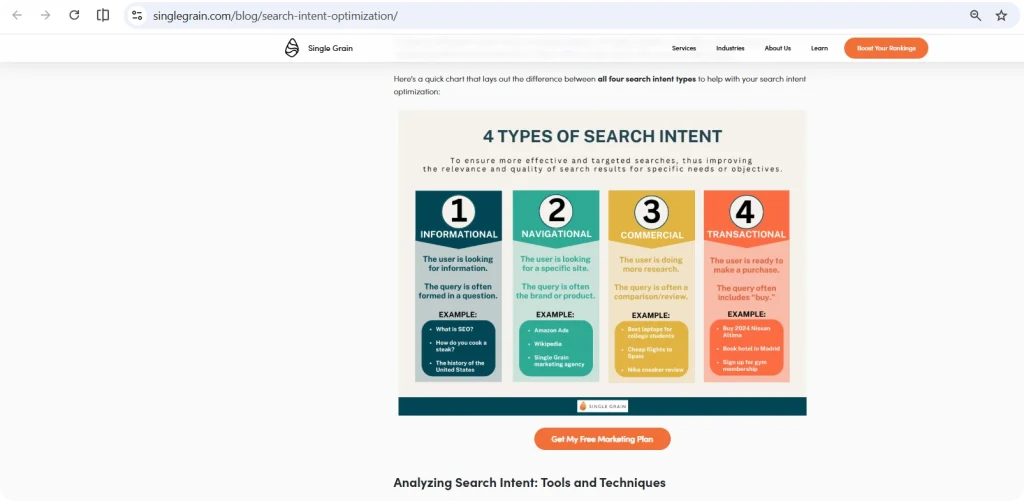
There are 4 main types of search intent:
- Informational: These types of content (blog posts, articles, guides) help readers to learn something and get new information.
- Navigational: This is when users want to land on a specific page or website.
- Commercial: Here, users want to find options, compare them, before actually making a purchase.
- Transactional: And as a last stage, users are ready to take action, such as buying or subscribing.
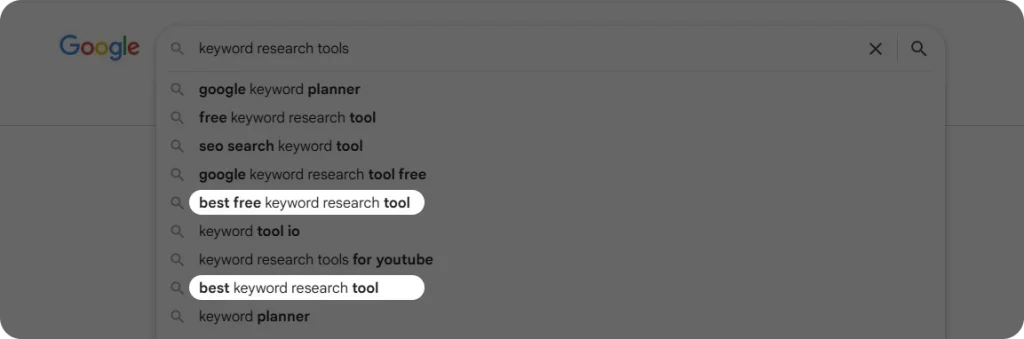
To identify the search intent, you can simply have a closer look at the Google search results and “People also ask” section, because each of the intents has a structure and its specific keywords, which is especially important for local SEO. For example, if the query is “how to” or “what is”, this is an informational intent, while keywords such as “best” or “top” are common for the commercial one.
Here’s an example of a commercial intent for “keyword research tools”.
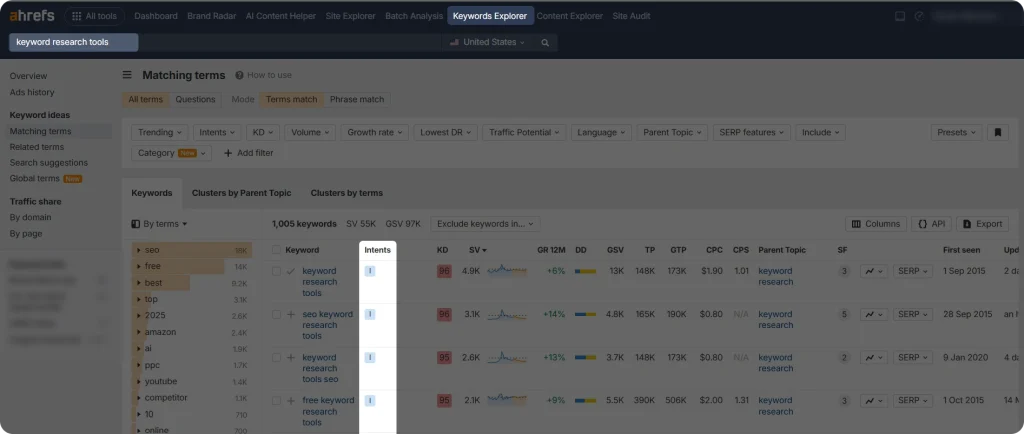
Many SEO tools, like Ahrefs, also show the search intent for each matching keyword of your target keyword. Here’s an example of Ahrefs.
- Just type your general keyword in the Keyword Explorer,
- Go to the Matching terms section,
- See the letters “I”, “N”, “C”, “T” for each matching keyword.
By understanding the search intent, you will be able to structure your content accordingly, target the right keywords, and ensure appearing in the SERPs at the right time.
Place Keywords Naturally
In SEO writing, your content is built around your primary and secondary keywords. To achieve this, you need to do keyword research and identify keywords that have high chances of ranking on SERPs (pay attention to KD and search volume). Tools like Ahrefs, Semrush, or Moz can help you with this research.
However, this doesn’t mean that adding as many of your target keywords as possible will benefit your rankings. In fact, keyword stuffing will make it even worse and lead to low rankings or not showing on SERPs at all.
Nothing new, just Google spam policies.
Now, if you are asking yourself what the rule of avoiding keyword stuffing is, here are some suggestions:
- Use keywords once every 200 words in your article.
- If they don’t fit in the paragraph or context, just don’t place them. Use synonyms or related terms instead.
- Make sure your primary keywords are present in your meta tags, Heading 1 (your title), intro, and conclusion (but only once or twice). Place in the subheadings only if relevant.
- After completing your article, re-read it to identify the sections with keyword overuse, because you might not notice it while writing.
To sum up, the general rule for avoiding keyword stuffing is to use your keywords evenly and naturally.
Use Relevant Visuals
Another way to optimize your article and improve its readability is by adding relevant and compelling visuals. Visual information is better digested than text-based information, so make sure you include visual elements too.
For example, if you are writing a tool review guide, you can include step-by-step screenshots so that your readers can follow along.
To support your point, you can also include video tutorials or charts.
In terms of SERP visibility, good visuals can increase your chances of appearing in Google featured snippets or AI Overviews. This can drive additional traffic to your content.
Here’s an example of a Google query for “what is search intent”. AI Overviews provided several sources on search intent and highlighted an informative chart explaining the differences of 4 intents provided by Single Grain. Later, after clicking on the visual, you are redirected to Single Grain’s relevant article, where you can find the visual.
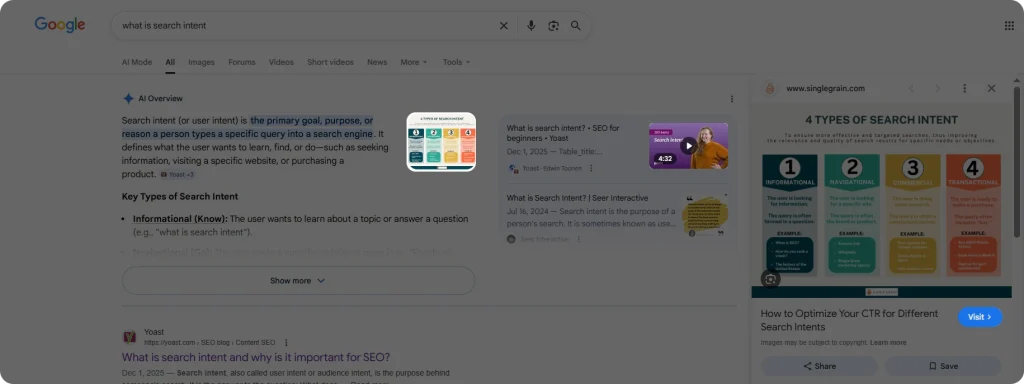
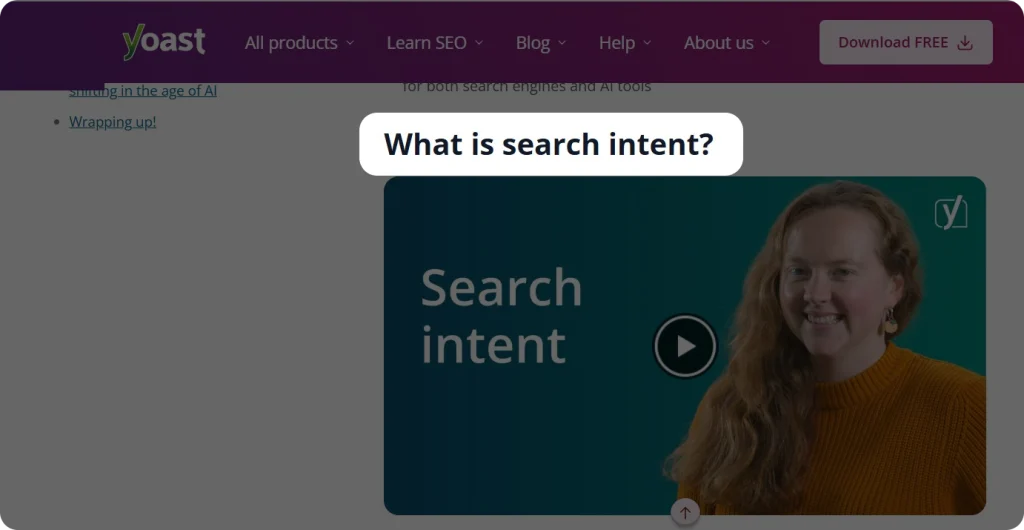
It also highlighted a video provided by Yoast SEO answering our “what is search intent” query.
Notice that in Yoast SEO’s article, the video is placed right under the “What is search intent?” heading to signal that the answer is explained in the video. And that’s how search engines considered it as a credible source to cite.
When placing your visuals, don’t forget to optimize alternative text (alt text) to explain to search engines what each image is about. Keep them short, preferably within 100 characters.
So, adding visual elements to your article can improve engagement, keep readers on the page longer, and may also help improve your visibility in search engines.
Add Internal and External Links
Internal and external links play an important role in SEO writing by improving content structure, credibility, and search engine understanding.
They also help increase authority across your website and support better rankings in SERPs.
- Internal links connect different pages within your website, helping users navigate more easily and allowing search engines to better understand your site structure.
- External links point to relevant and trustworthy sources outside your website, which can increase credibility and provide additional value to readers.
Therefore, using both internal and external links strategically enhances user experience and strengthens your content’s SEO performance.
SEO Writing: The AI Trends
Today, people use AI search engines (such as ChatGPT, Claude, or Gemini) to find answers to their queries. This tendency sets its rules in SEO writing, where your goal is to be cited by AI platforms, too.
Have you ever noticed how AI search engines answer your questions and which sources they rely on? By analyzing these patterns, you can refine your article structure to increase your chances of being cited by AI systems.
Here are some points to consider:
- As said before, your article should be easy to scan, with clear headings, well-defined sections, and concise paragraphs. Formats such as question-and-answer or term-and-definition can make it easier for AI to extract information.
- Focus on writing credible and reliable content, as accuracy and trustworthiness are key factors for being cited.
- Consider using listicles, as structured lists make information easier to process and more likely to be picked up by AI.
- Focus on your brand mentions across different sources. This way, your product or service will have higher online visibility and more chances to get featured on AI search engines.
And after your AI search optimization efforts, use SEO tools to track important AI visibility metrics. For example, Ahrefs’ brand radar does just that by comparing your brand’s and your competitors’ AI visibility across various AI platforms like AI Overviews, AI Mode, ChatGPT, or Gemini.
So, optimizing your content for search engines and AI search platforms should go hand in hand, as both are important for ensuring your brand’s long-term visibility and success.
The Bottom Line
SEO writing requires specific practices to ensure content ranks on search engines and AI platforms. But this doesn’t mean that your content should sound robotic with keywords mentioned in every corner.
As search algorithms continue to change, it is more important than ever to create compelling, informative content that adds value to your audience.
If you are new to the field, you can also take an SEO writing course to learn the essential techniques and gain hands-on practice.
In short, the best results come from balancing optimization techniques with natural, people-first writing.