
Digital Marketing

  • Digital Marketing Course vs. MBA Marketing: Which Delivers Better Career Growth?

    Digital Marketing Course vs. MBA Marketing: Which Delivers Better Career Growth?

    Marketing has kind of changed, past the usual ads and more straightforward sales strategies. Most businesses now depend a lot on online channels, data analytics, social media, search engines, and content marketing to actually meet their audiences where they already are. So, people trying to build a marketing career end up asking a very real question: Should I do a digital marketing course or should I take an MBA in Marketing?

    Both choices can open doors into the industry, but they’re not the same at all. They vary in curriculum, time required, overall cost, hands-on exposure, and even the kinds of career results you can expect. If you can see those differences clearly, you can pick the path that fits your career aims better, not just what sounds good on paper.

    This guide walks through the main parts of both learning options and points out which one tends to support stronger career growth in today’s competitive market. 

    What Is a Digital Marketing Course and Why Is It So Popular?

    A digital marketing course is a professional course that equips individuals with competencies like SEO, social media marketing, Google Ads, content marketing, email marketing, and web analytics. This course has gained popularity since companies are adopting various digital methods to get clients and grow their operations, which calls for competent digital marketers.

    Unlike traditional marketing training programs, a digital marketing course offers job-ready skills that are easy to apply at work. Boston Institute of Analytics provides industry-oriented digital marketing courses that allow professionals to succeed in this rapidly growing industry.

    A typical digital marketing course covers:

    • Search Engine Optimization (SEO)
    • Search Engine Marketing (SEM)
    • Social Media Marketing
    • Content Marketing
    • Email Marketing
    • Web Analytics
    • Performance Marketing
    • AI-Powered Marketing Tools
    • Marketing Automation

    The rise in the popularity of digital marketing is associated with the need of companies of all sizes for professionals capable of producing tangible results from their digital efforts. Through a digital marketing course, it becomes possible to gain relevant digital marketing skills quite quickly.

    Boston Institute of Analytics places emphasis on practical studies and enables learners to learn how digital campaigns are organized and managed in real business environments.

    What Is an MBA Marketing and What Does It Cover?

    An MBA Marketing is a postgraduate course that is a blend of business management courses along with marketing management skills. Some of the important topics covered under this course include marketing management, consumer behaviour, brand management, market research, sales management, strategic planning, finance, and leadership. An MBA Marketing is generally offered with the main objective of building managerial and decision-making skills.

    Although an MBA Marketing can be helpful in providing you with a good background on business management, it might not cover all aspects of current-day digital marketing. This is why most people choose to supplement their education by taking up training offered at the Boston Institute of Analytics.

    The program generally includes:

    • Marketing Management
    • Consumer Behaviour
    • Brand Management
    • Sales Management
    • Strategic Management
    • Finance
    • Human Resource Management
    • Business Analytics
    • Organizational Leadership

    The purpose of MBA programs is usually to build managerial and leadership skills, and not just digital marketing skills. Although digital marketing is one of the core specializations, there is much more focus on business administration.

    Why Are More Students Choosing a Digital Marketing Course Today?

    The number of students opting for a digital marketing course has increased because there is an increasing need for digital marketing specialists within the corporate world. Organizations are using the power of the Internet and social media sites to reach out to potential customers; this has provided many job options in this field.

    A digital marketing course provides students with training that is more geared towards helping them secure employment after completing the course. Students can acquire necessary skills faster than in a traditional degree program, and they can learn how businesses market their products or services nowadays. Boston Institute of Analytics prepares students for industry standards via various means.

    Several influences contribute to the growing approval of a digital marketing course:

    Is Industry Demand Driving the Growth of Digital Marketing Careers?

    Certainly. There is considerable expenditure by organizations on digital platforms due to the time spent by customers online. Specialized professionals are required to understand social media strategies, search engines, advertising, and customer analysis. A digital marketing course provides learners with knowledge that employers look for.

    Does a digital marketing course Offer Faster Career Entry?

    The duration taken for completion of a digital marketing course is shorter than an MBA. It means learners can join the workforce quickly and start gaining experience. The Boston Institute of Analytics has provided learning opportunities tailored to meet the needs of the industry.

    How Does a Digital Marketing Course Differ from MBA Marketing in Learning Approach?

    The major difference between a digital marketing course and an MBA Marketing lies in the methodology of learning. The digital marketing course comprises more skill-oriented classes wherein the learners will be allowed to engage in actual project work and implement digital marketing campaigns, SEO, social media marketing, and analyze using various software tools.

    On the other hand, MBA Marketing consists of learning business topics that include but are not limited to management, leadership, finance, and consumer behaviour, among others. Although an MBA provides extensive knowledge about business administration, the course on digital marketing prepares learners for the immediate needs of the market.

    Boston Institute of Analytics closes this gap through practical training in digital marketing.

    Does a digital marketing course Focus More on Practical Skills?

    Yes. Most digital marketing course agendas emphasize hands-on learning.

    Students typically work on:

    • Live campaigns
    • Website optimization projects
    • Google Ads campaigns
    • Social media strategies
    • Analytics dashboards
    • Content creation projects

    This practical approach helps learners understand real business challenges.

    Does MBA Marketing Focus More on Theory and Management?

    MBA programs often underline business theories, management frameworks, and organizational strategy.

    While these concepts are valuable for guidance roles, they may not always provide the technical expertise needed for modern digital marketing platforms.

    Which Option Provides Better Job Opportunities?

    In relation to employment opportunities, it is important to highlight that the digital marketing course offers the learner a greater number of rapidly emerging job openings in the contemporary digital economy. Corporations of all kinds have been searching for individuals who have mastered skills in SEO, social media marketing, performance marketing, content marketing, and web analytics.

    While an MBA Marketing can help one become a manager, many companies would benefit from hiring candidates who are experienced in the digital realm. The digital marketing course enables students to learn employable skills that will help them get jobs straight away.

    The Boston Institute of Analytics trains its students in such a way that they are able to acquire industry-specific skills.

    What Jobs Can You Get After Completing a Digital Marketing Course?

    Graduates can pursue roles such as:

    • Digital Marketing Executive
    • SEO Specialist
    • PPC Specialist
    • Content Marketing Manager
    • Social Media Manager
    • Email Marketing Specialist
    • Marketing Automation Specialist
    • Digital Analytics Professional
    • Performance Marketing Expert

    These positions are in demand across start-ups, multinational businesses, agencies, and e-commerce businesses.

    Boston Institute of Analytics prepares students for these evolving roles by meeting industry-relevant digital skills.

    What Jobs Can You Get After Completing MBA Marketing?

    MBA graduates often pursue places such as:

    • Marketing Manager
    • Brand Manager
    • Sales Manager
    • Business Development Manager
    • Product Marketing Manager
    • Market Research Analyst

    While these roles can be gratifying, many employers now also guess candidates to possess digital marketing expertise.

    How Does Salary Growth Compare Between a Digital Marketing Course and MBA Marketing?

    Salary increments for either a digital marketing course and MBA Marketing depend on various aspects such as skillset, experience, industry, and job performance. 

    While an MBA Marketing might provide one with managerial-level job opportunities, a digital marketing course provides one with specializations in SEO, website marketing, digital analytics, and digital advertising, among others, fields whose demand is steadily growing.

    With companies increasingly focusing on their digital transformation processes, people skilled in digital marketing practices stand out to earn lucrative salary increments. At the Boston Institute of Analytics, the learner is provided with relevant skills for the contemporary job market.

    Can a digital marketing course Lead to High-Paying Careers?

    Yes. Digital marketing experts with unique competencies in performance marketing, analytics, automation, and AI-enabled marketing campaigns usually earn competitive salaries. With the growing importance of online success for businesses, digital marketers who possess such competencies can look forward to fast-growing careers. 

    Enrolling in a digital marketing course at Boston Institute of Analytics allows you to develop expertise in fields that will help you grow your salary.

    Does MBA Marketing Offer Strong Salary Potential?

    Starting salaries for MBA graduates may be lucrative, especially when you graduate from a reputable business school. Nevertheless, long-term growth requires practical experience and the ability to adapt to emerging marketing technology.

    Why Is Practical Experience Important in a Digital Marketing Course?

    Hands-on experience is essential for students learning in a digital marketing course because, through hands-on experience, they would be able to utilize the theories they’ve learned to solve marketing problems. Getting practical experience in performing tasks such as SEO, social media marketing, Google AdWords, content marketing, and analytics would enable students to become better at problem-solving.

    It could also happen that the employer prefers a candidate with practical experience over one who possesses only theoretical experience. By doing projects on a live basis, students would be able to build a portfolio which could benefit their careers in the future. Such industry-driven projects are provided by Boston Institute of Analytics.

    Does Hands-On Learning Improve Employability?

    Yes. Practical projects help students:

    • Build portfolios
    • Gain confidence
    • Understand campaign management
    • Develop analytical thinking
    • Learn problem-solving skills

    A digital marketing course with real-world project-based learning may have a suggestive role in improving job readiness. Learning through experimentation is one of the core focuses at Boston Institute of Analytics and provides practical exposure.

    Can Practical Experience Help During Interviews?

    Absolutely. Candidates able to speak on campaign performance, optimization, and results are often those who catch the attention during interviews. Experience proves capability more than any other qualification.

    How Should Students Decide Between a Digital Marketing Course and MBA Marketing?

    The choice between digital marketing course and MBA Marketing can be made by individuals based on the basis of their career plans, interests, and other professional factors. Students who want to acquire practical skills and expertise in domains such as SEO, Social Media Marketing, Performance Marketing, and Analytics would prefer a digital marketing course.

    By contrast, students who wish to develop themselves as leaders and managers with a broad outlook and decision-making skills may find an MBA in Marketing more suitable. Other factors that must also be considered include the duration, price, and market demands for each program.

    Boston Institute of Analytics helps its students develop future-ready digital marketing skills through effective industry-oriented education and training.

    Should You Choose a digital marketing course If You Want Job-Ready Skills?

    However, if your goal is to get practical knowledge in marketing and join the job immediately, then taking up the digital marketing course would be more appropriate for you as it teaches skills that are in demand from companies. Boston Institute of Analytics offers all-inclusive programs for digital marketing courses tailored to the needs of current job markets.

    Should You Choose MBA Marketing If You Want Broad Business Knowledge?

    On the other hand, an MBA could be a better choice for those seeking a complete overview of management and a career in leadership positions. But even after completing their MBA degree, people often take up further training in digital marketing.

    Why Is Boston Institute of Analytics a Strong Choice for a Digital Marketing Course?

    The Boston Institute of Analytics is an excellent institute for taking up a digital marketing course due to its well-balanced curriculum and practical learning experience. 

    The Boston Institute of Analytics offers courses that help in gaining knowledge about important digital marketing skills like SEO, social media marketing, performance marketing, content marketing, web analytics, and marketing automation. 

    The curriculum of the course offered by the Boston Institute of Analytics is prepared in accordance with the requirements of the current industry, thus equipping the learners with job-specific and relevant skills along with problem-solving skills. Due to this reason, the Boston Institute of Analytics offers an excellent opportunity for aspiring marketers.

    Boston Institute of Analytics focuses on:

    • Industry-relevant curriculum
    • Practical learning experiences
    • Real-world projects
    • Advanced marketing technologies
    • Analytics-driven decision making
    • Career-focused skill development

    The digital marketing course programs offered by Boston Institute of Analytics are designed to bridge the gap between academic learning and industry needs, helping students build self-assurance and employability. 

    Final Thoughts

    The marketing world is witnessing a massive change, with digital platforms leading the way for growth in this industry. Where MBA Marketing would give a general exposure to business management, a marketing course will provide a more specific skill set required in the current market scenario.

    For those who need quick employment opportunities and career-oriented training, a digital marketing course in India seems like the right choice in comparison to pursuing an MBA degree. Given that businesses are making their way into digital space, it appears likely that there will always be a demand for people who can help them navigate the digital world.

    Boston Institute of Analytics helps young marketers get equipped with career-oriented digital marketing course programs.

    FAQs: Digital Marketing Course vs MBA Marketing: Which Delivers Better Career Growth?

    Which option offers better career growth: A digital marketing course or an MBA Marketing?

    A digital marketing course can be said to offer quicker opportunities in developing skills that would suit their job requirements. As mentioned earlier, while an MBA Marketing provides broad business management skills, Boston Institute of Analytics will assist learners to develop industry-ready digital marketing skills.

    Is a digital marketing course more job-oriented than an MBA Marketing?

    Certainly, a digital marketing course enables learners to develop practical skills in different fields, including search engine optimization, social media marketing, paid advertising, and analysis. Boston Institute of Analytics aims to offer practical training that prepares learners for their career advancement.

    Can a digital marketing course help students get jobs faster than an MBA Marketing?

    A digital marketing course is more likely to take a shorter time compared to an MBA Marketing. Learners will be able to acquire more skills that could increase their employability in the job market at Boston Institute of Analytics.

    Does a digital marketing course offer better opportunities in the current job market?

    The need for skilled digital marketers is on the rise as organizations leverage more of the Internet. With its state-of-the-art curriculum for digital marketing skills, a digital marketing course from Boston Institute of Analytics is ideal for someone who wants to explore the vast world of marketing careers.

    Is a digital marketing course suitable for working professionals?

    Absolutely! The digital marketing course is great for working professionals who wish to update themselves or make a switch to marketing jobs. Boston Institute of Analytics provides industry-specific learning that allows individuals to boost their careers without having to spend years studying in college.

    Can a digital marketing course lead to high-paying career opportunities?

    Some examples of fast-growing job positions include those involved in performance marketing, analytics, content strategy, and digital advertising. Boston Institute of Analytics prepares professionals to acquire relevant skills that will enable them to earn well in the future.

    How does a digital marketing course prepare students for future marketing trends?

    The course in Digital Marketing will help one learn new trends like marketing automation, data analytics, and AI-based marketing approaches. Boston Institute of Analytics incorporates the use of technology into its digital marketing course curriculum to prepare learners for the coming challenges of digital marketing.

    Is a digital marketing course more practical than an MBA Marketing?

    digital marketing courses usually emphasize the practical aspect including projects, live campaigns, and tools used in the industry. Boston Institute of Analytics ensures that its learners get hands-on experience to help them gain the confidence needed for employment.

    Who should choose a digital marketing course instead of an MBA Marketing?

    An individual looking for a special skill set for marketing and career entry within a shorter period can find the digital marketing course very helpful. The training provided at Boston Institute of Analytics is intended to equip one with skills required in the field of digital marketing.

    Why should students consider Boston Institute of Analytics for a digital marketing course?

    Boston Institute of Analytics provides an excellent opportunity through its digital marketing course. This course is career-oriented and provides an overall learning experience.

  • Using WooCommerce’s WordPress Foundation for Content-Led Ecommerce SEO

    Using WooCommerce’s WordPress Foundation for Content-Led Ecommerce SEO

    Content is an afterthought at most e-commerce sites. Product pages go up, a few category descriptions get written, and the blog collects dust between seasonal promotions. In WooCommerce, built on WordPress, content is a first-class citizen with the same level of infrastructure and flexibility that dedicated publishing platforms are built around. 

    For store owners who recognize this, it is one of the most underused advantages in online retail and one of the few areas where a well-run WooCommerce store can build a lead that pure commerce platforms simply cannot close.

    The SEO Gap That Most E-Commerce Platforms Cannot Close

    Spend any time comparing e-commerce platforms from an SEO angle, and a pattern emerges quickly. Hosted platforms like Shopify and BigCommerce cover the technical basics well enough, but their content capabilities are limited by design. They are commerce platforms first, content platforms second. Building topical authority across a product category requires the kind of deep content infrastructure that most hosted platforms were never designed to support.

    That gap shows up in predictable ways:

    • Blogging exists, but lacks real editorial depth or flexibility
    • Content and commerce operate as separate layers rather than one integrated system
    • The interconnected content architecture needed for sustained organic growth simply isn’t available at the level a dedicated CMS provides

    WooCommerce is in a whole different situation. It’s built on WordPress (the world’s most 

    popular content management system), and so it offers a package of features and options that are second to none, especially when it comes to content management. WooCommerce offers all of WordPress’s post types, taxonomies, custom fields, and workflows for editing posts. Commerce layer and content layer are truly integrated, and that makes the SEO strategy that can be carried out on a WooCommerce store just much stronger than any pure commerce platform.

    Not all WooCommerce store owners take advantage of this. Many use the blog for occasional announcements and treat product pages as their only SEO surface. The stores that invest properly in content-driven SEO build organic search presences that compound over time and become very hard for competitors to match. 

    Why Content-Led SEO Works Differently for E-Commerce

    Content-led SEO isn’t about having a blog. It’s about building a content framework that matches search intent at every stage of the buyer’s journey:

    • Awareness: informational queries where shoppers are learning and researching
    • Consideration: comparison content that helps narrow down options
    • Transaction: product and category pages built for purchase intent

    When someone wants to buy a standing desk, they rarely start with a specific product search. They start with questions: best standing desk heights, do standing desks improve productivity, fixed vs. adjustable. These informational queries carry significant search volume and far less competition than the direct product terms every e-commerce store fights over. 

    A site that answers these questions well, and links them intelligently to product and category pages, earns the visitor’s trust long before they are ready to buy.

    WordPress makes this kind of content organization straightforward. Categories, tags, custom post types, and internal linking at scale are all built in. On most other platforms, replicating this would require considerable workarounds.

    In competitive e-commerce categories, the stores that win organic search are not always the ones with the best product pages. They are the ones who earn the visit before the purchase decision is even made.

    Structuring the Content Architecture for SEO Impact

    Mapping the Search Landscape First

    The gap between a blog that gets occasional traffic and a content strategy that keeps growing comes down to structure. Random publishing produces random results. A planned content architecture, built around real search demand for the store’s products and customers, creates rankings that reinforce each other over time.

    Understanding why internal SEO links matter goes beyond navigation and is the foundation of any content architecture that actually performs in search.

    Before publishing anything, every piece of content should clearly answer three questions:

    • Which keyword is it targeting?
    • Which stage of the buyer’s journey does it serve?
    • Which commercial page does it support through internal linking?

    Technical Implementation in WooCommerce

    In WordPress and WooCommerce, this structure is put into practice through post categories that reflect the product taxonomy, internal linking that connects informational and transactional content in both directions, and URL structures that communicate topical relevance to search engines.

    Getting this right from the start is far more effective than retrofitting it later. It’s also the kind of basic-level work that will truly combine the expertise of experienced WooCommerce Development Services and SEO strategy, as it’s not possible to implement the technical part without understanding the content strategy, and vice versa. 

    Product and Category Pages as Content Assets

    Content-led SEO applies to the commerce layer too, not just editorial content. Product pages and category pages are content assets, and they are consistently underdeveloped in most WooCommerce stores. Many category pages are little more than a product grid with filters, which leaves a lot of organic search opportunity unused.

    WooCommerce makes it easy to go further. A well-built category page can include:

    • An introduction optimized for the primary keyword
    • Copy that addresses common buyer questions
    • Links to supporting content that builds topical authority

    Product pages can be developed with original, substantive content that informs the customer and gives search engines something meaningful to rank, rather than duplicated manufacturer descriptions found across dozens of other stores.

    Schema markup is another area where WooCommerce’s WordPress foundation provides a structural edge. Implemented cleanly and at scale, the right schema types improve how search engines understand and display the store’s content:

    • Product schema: price, availability, and product details in search results
    • Review schema: star ratings that lift click-through rate
    • Breadcrumb schema: site structure shown directly in the SERP
    • FAQ schema: expanded listings that capture more visibility and answer intent

    This kind of work sits at the intersection of development and content strategy, and it produces the best results when both disciplines are genuinely working together.

    Building Domain Authority Through Content That Earns Links

    One of the strongest long-term benefits of WooCommerce’s WordPress foundation is what it makes possible for link acquisition. Editorial content, original research, and useful tools attract inbound links from other publications and industry sites in ways that product pages simply cannot.

    A WooCommerce store with a proper content operation can build the kinds of assets that earn links naturally:

    • Original data studies and industry research
    • Definitive category guides that become go-to references
    • Interactive tools that solve real problems for the target audience

    These won’t drive immediate traffic to product pages, but the domain authority they build has a compounding effect on overall organic search performance. Domain authority is one of the few things in SEO that cannot be bought or replicated quickly, which is exactly why consistent investment in it creates a lasting competitive edge. That investment means paying close attention to backlink quality, since a smaller number of relevant, high-authority links will always outperform a large volume of weak ones. 

    To make this work, content strategy, development architecture, and ongoing technical SEO need to function as one connected system. The right WooCommerce development services partner understands that the store’s technical infrastructure exists to enable its content strategy, and builds with that in mind so every piece of content published has the best possible chance of ranking, converting, and building value over time.

    Final words

    WooCommerce’s WordPress foundation is a strategic advantage that most store owners never fully use. When content architecture, internal linking, schema markup, and domain authority building work together as one system, the result is organic growth that compounds over time and becomes hard for competitors to match.

    That does not happen by accident. It requires the right technical setup, a clear content plan, and consistent execution. For WooCommerce stores willing to commit to that approach, the opportunity is wide open.

  • Types of Keywords in SEO։ Meaning, Examples, and Uses

    Types of Keywords in SEO։ Meaning, Examples, and Uses

    Keywords are not just random words or phrases used in your content. 

    They vary based on different factors, such as their goals, roles, or structure. And exploring these differences will give you clearer insights into how to build your content strategy.

    Read along to uncover the most common types of keywords in SEO with examples, as well as how to find each of them.

    What Are Keywords? Their Importance in SEO

    Keywords are words or phrases users type in Google or other search engines to find answers or information. Those can be anything from one-word keywords to long phrases or questions. 

    Thus, properly optimizing your content with relevant keywords helps search engines determine:

    • Whether it matches users’ search queries 
    • Whether it deserves to appear as a relevant answer source in search results.

    This is where understanding different types of keywords comes into play, as they are an important part of the SEO keyword mapping and keyword optimization process.

    The Main Types of Keywords: Grouped and Explained

    Now that the importance of learning about the keyword types is clear, let’s see what the main types of keywords are. 

    To make it more structured and clearer, we have grouped the types by their goals and meanings.

    • Intent-Based Keywords

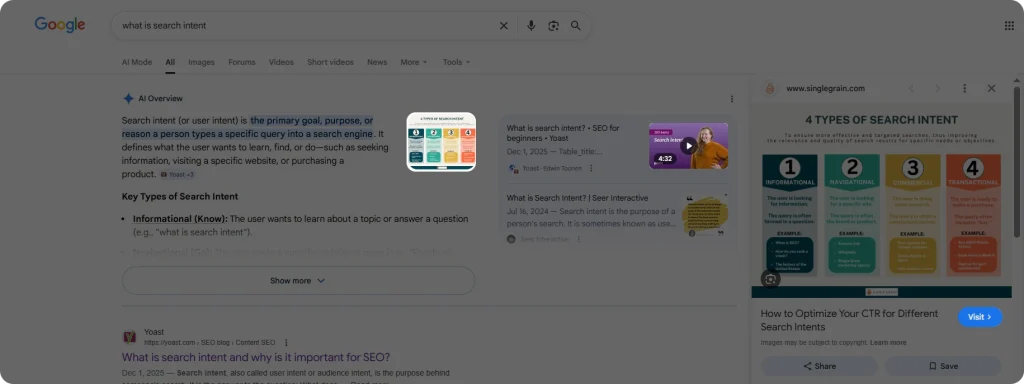
    These keywords reflect the user’s search intent (the purpose or reasoning behind a search query).

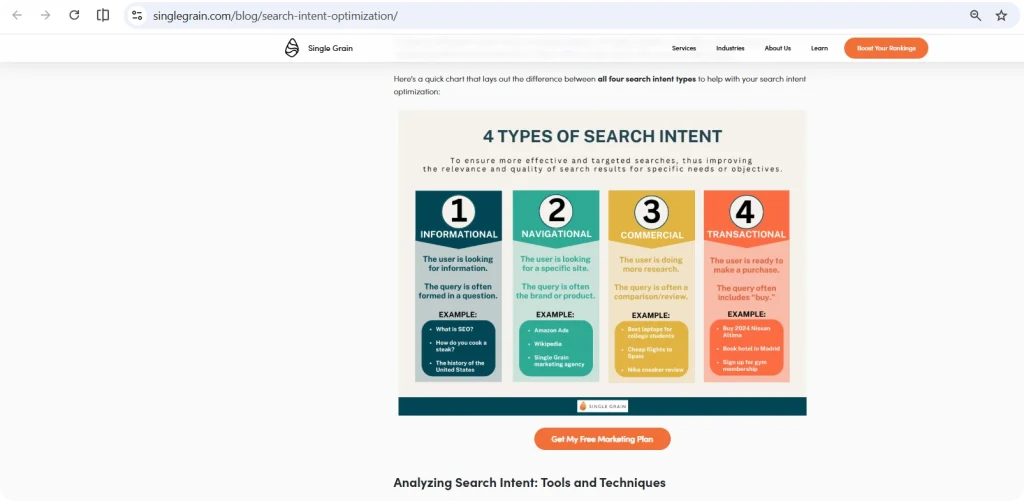
    There are four types of intent-based keywords:

    Informational: Users want to get some information (for example: why is SEO important?)

    Navigational: They want to land on a specific website or platform (for example: Instagram login)

    Commercial: Users are still in the research phase before making a purchase (for example: best SEO tools review)

    Transactional: They are ready to make a purchase (for example: subscribe to Netflix)

    As you may have noticed, each type of keyword often includes specific words that signal the category it belongs to. 

    • Informational: “What?”, “Why?”
    • Navigational: “login”, “sign in”
    • Commercial: “best”, “top”, “review”
    • Transactional: “buy”, “purchase”

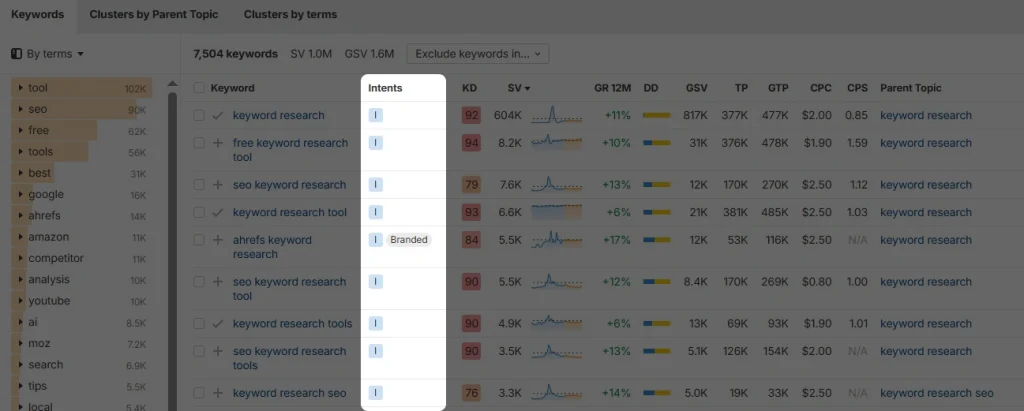
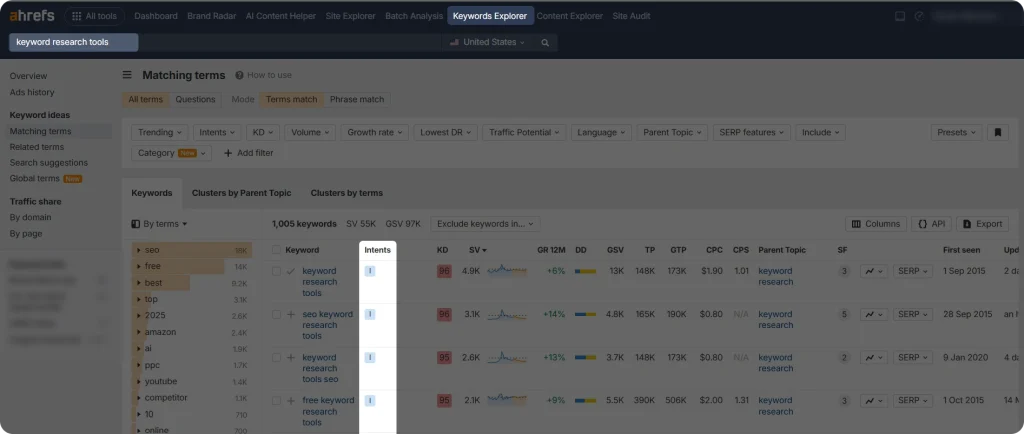
    To quickly identify keyword intent, consider using SEO tools. They are designed to browse dozens of keywords with their intents in seconds, so that you don’t have to check them manually. 

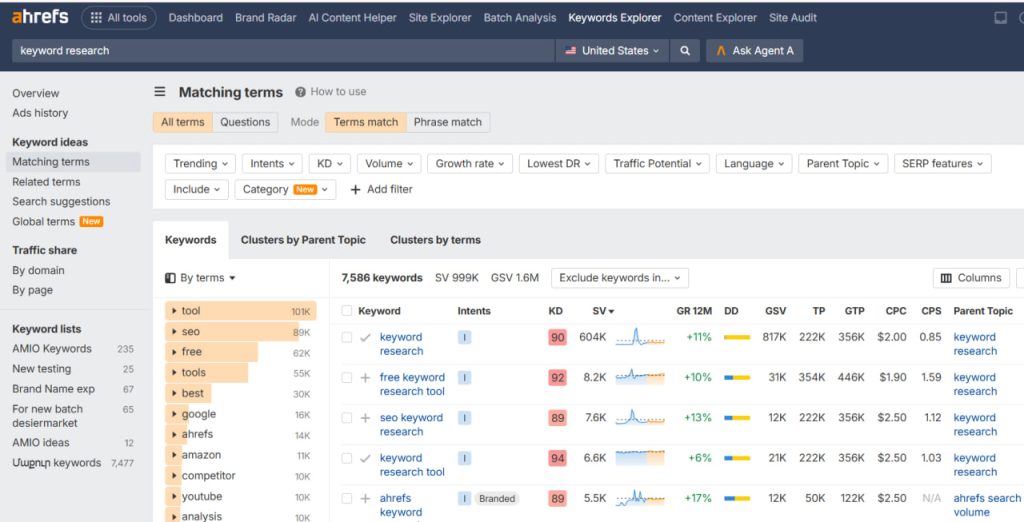
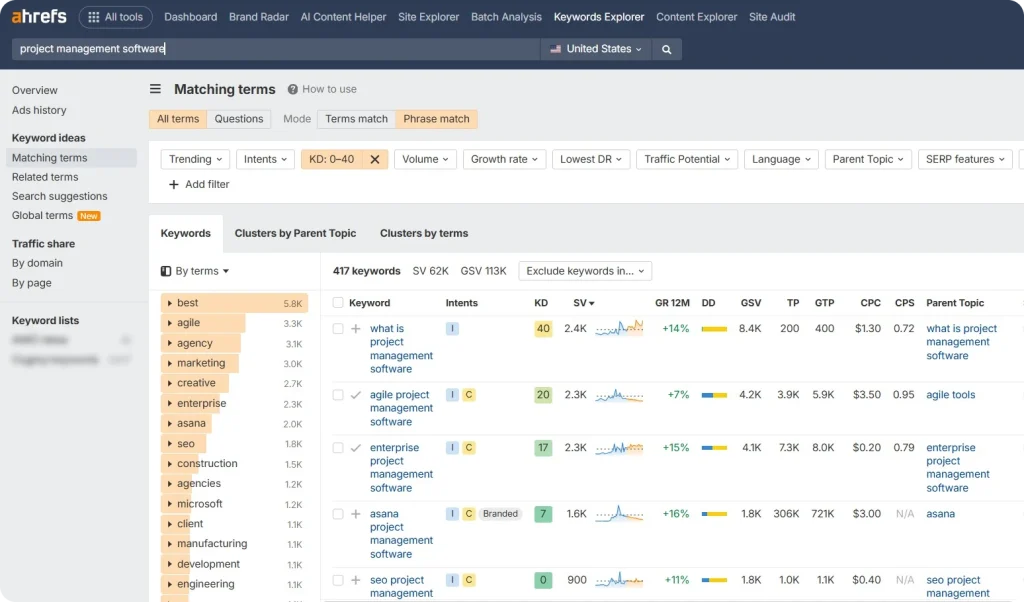
    In the example below, Ahrefs, one of such tools, has a special column for showing the intent right next to each keyword.

    • First, log in to your Ahrefs account
    • Go to the “Keywords Explorer” section and type your keyword.Screenshot of Ahrefs Keyword Explorer tool

    In the “Terms match” section, you will find the relevant intent letter (I, N, C, T) next to each of the suggested keywords. You can also identify which of the keywords are branded.

    • Structure-Based Keywords

    There are two types of keywords based on their structure, search volume, and competitiveness: long-tail and short-tail.

    • Short-tail: Short-tail keywords are keywords consisting of up to 3 words (for example: keyword research). They are broad and have high keyword search volumes. Therefore, they are also highly competitive as they are targeted more.
    • Long-tail: The name tells for itself. These are the longer versions of keywords, usually including 4 or more words (for example: keyword research tools for small businesses). They are more specific and therefore have lower search volume than short-tail ones. 

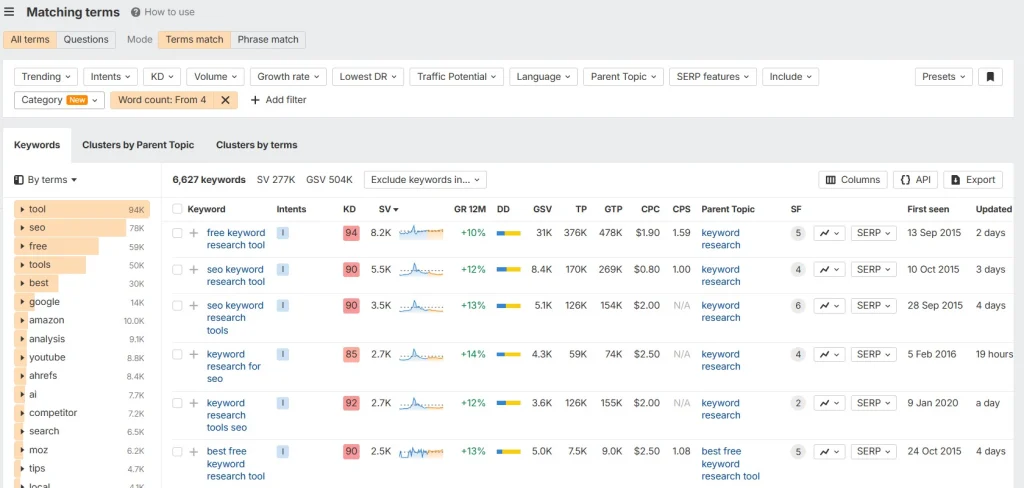
    To identify short-tail and long-tail keywords on Ahrefs, you can simply see which of the keywords in “Terms match” have up to 4 or more. 

    Pro tip: To find long-tail keywords faster, add the “Word count” filter starting from 4 words.

    Banner image of Ahrefs Keyword Research tool

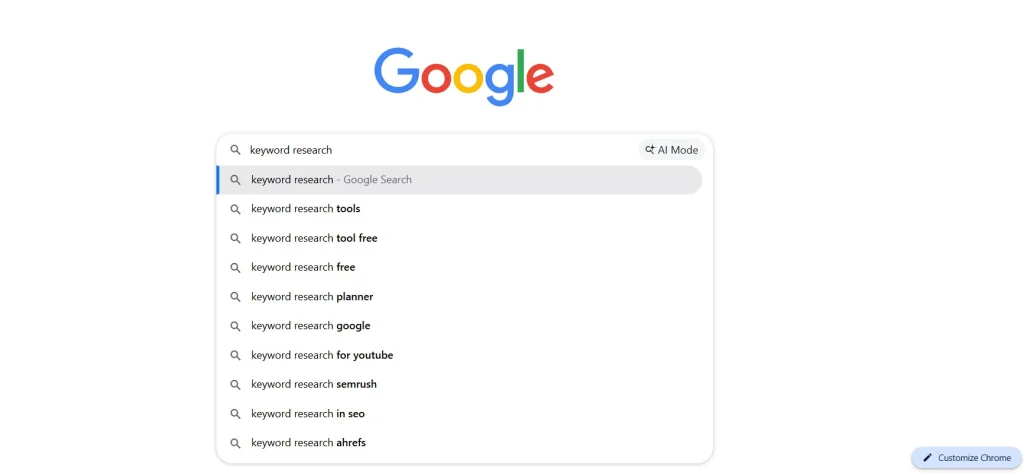
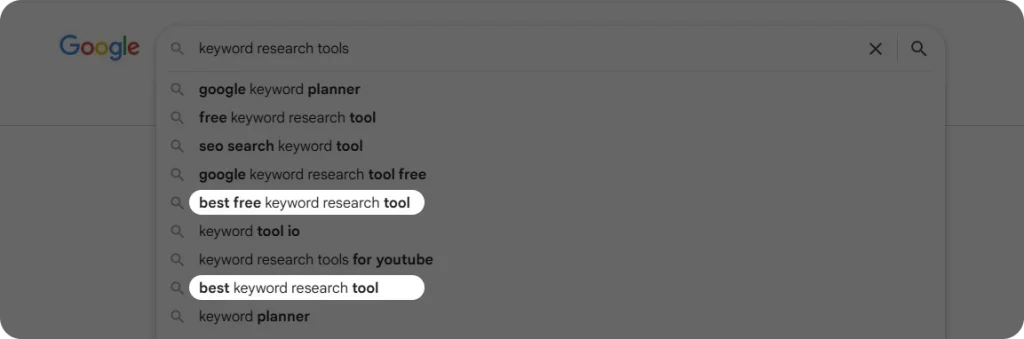
    Google’s autocomplete feature can also help you find both short-tail and long-tail keywords. Just go to the Google search bar and type your search keyword or focus keyword to see what results appear below.

    Screenshot of Google search

    It is worth noting that there is no strict rule for which one of these keywords is the best for your SEO strategy. Using the best SEO tool can help you evaluate both options based on your goals, website potential, and resources.

    • Role-Based Keywords

    We named this group “target-based” because the keywords in this group differ in their target goals and why they are used in content strategies.

    • Seed keyword: The seed keyword is the initial keyword you use to start your keyword research. It is broad, general, and usually consists of one or two words.
    • Focus keyword: The focus keyword (also known as the primary keyword) is the main keyword you want your content to target and rank for. It serves as the central topic around which your content is built. 
    • Secondary keyword: These are supporting keywords related to your focus keyword. They also have ranking potential, and using them naturally and relevantly throughout your content can strengthen your SEO writing efforts and improve your chances of ranking for multiple search queries. 

    Again, each of these keywords can be used for different purposes and in different ways. 

    If it is a seed keyword, it is mainly used at the very beginning of your keyword research stage. It helps you find more keywords that have a ranking potential and can be used in your content. They also help you understand your content direction and strategy.

    Meanwhile, your focus keyword should strategically be placed in headings, meta tags, the introduction, and the conclusion of your article. This is important for signaling search engines on what you are targeting in your content. But beware of keyword stuffing. 

    And finally, secondary keywords can be simply placed in different sections of your article based on relevance.

    Why is it Important to Master the Types of Keywords?

    At first, it might seem like learning all the different keyword types will not make much difference when building your SEO strategy. 

    In reality, understanding how keywords work and what purpose each type serves can help you create more targeted and effective content. 

    Using the right keywords allows you to connect with the right audience at the right stage of their search journey, which can improve both rankings and conversions:

    • Right targeting: Different keywords attract different audiences. So, using the right type of keyword will help you reach users with the right intent and provide content that matches their needs. 
    • Defining your strategy: Understanding keyword types makes it easier to plan your content strategy and prioritize SEO efforts.

    In addition, mastering keyword types can: 

    • Strengthen your chances of ranking higher in search engines
    • Help you compete more effectively in your industry. 

    A well-structured keyword strategy also prevents you from targeting the wrong audience or creating content that fails to meet user expectations.

    To Wrap Up

    Keywords play a major role in building an effective content strategy. 

    Understanding the different types of keywords gives you an even greater advantage when it comes to targeting the right audience. 

    By choosing keywords based on search intent, you can create content that better matches what users are actually looking for at every stage of their online journey.

    To get the best results, do your keyword research, analyze search intent carefully, and build your content around the most relevant keyword types. 

    This approach will help your content appear in front of the right audience at the right time, increasing your chances of driving meaningful traffic, engagement, and conversions for your brand.

  • How to Find Orphan Pages: Steps Review

    How to Find Orphan Pages: Steps Review

    If you’re wondering why certain pages on your website, like blog posts or product pages, aren’t performing well online, the issue may not be the content itself.

    In many cases, those pages are simply invisible to search engines. That’s why it’s important to understand how to find orphan pages and make sure they are properly connected to your site.

    In this article, you’ll learn what orphan pages are, how to find and fix them, and why fixing orphan pages is essential for your SEO performance in the first place. 

    What Are Orphan Pages?

    Orphan pages are pages on your website that have no internal links pointing to them from any other part of your site. 

    It is like you are creating an internal document and saving it somewhere no one can access via normal navigation. The document exists, but others can only find it if you share its link directly.

    And the issue of having orphan pages on your website may have an impact on your website’s SEO performance.

    Why You Should Find and Fix Orphan Pages?

    Imagine you have a new page on your website, but there are no internal links from other pages pointing to it (maybe you just forgot, it happens). And if the page is not included in your sitemap and has no backlinks from other websites, you are making it much harder for search engines to find and index your page. In this case, how will Google or users discover that the page even exists? 

    Your page will turn into a ghost wandering online. It is there, but it is not seen. 

    So, there are two main reasons why finding and fixing orphan pages is important for your website’s SEO:

    • It helps search engines discover, crawl, and index your pages more effectively
    • It improves user experience by making it easier for visitors to navigate your website and find the content they need
    • A proper internal linking strategy helps search engines better trust your website, which can lead to improved visibility and performance in search results. 

    The importance of internal links is obvious, and Google explains it best: 

    “You may usually think about linking in terms of pointing to external websites, but paying more attention to the anchor text used for internal links can help both people and Google make sense of your site more easily and find other pages on your site. Every page you care about should have a link from at least one other page on your site. Think about what other resources on your site could help your readers understand a given page on your site, and link to those pages in context.”

    And Finally, Here is How to Find Orphan Pages 

    Given the importance of fixing orphan pages on your site, let’s now look at the practical steps to find them.

    • Manual Google Search

    The first method for finding orphan pages on your website is to search manually using a simple Google search. While this approach can be time-consuming, it works well for smaller websites with a limited number of pages.

    To start, you can review your sitemap data. In most cases, you can access it by typing example.com/sitemap.xml into your browser. If your site doesn’t have one, you can generate a sitemap using online tools or plugins.

    • Once you have your sitemap, go through the listed URLs and check whether those pages are internally linked from other parts of your website. If you find pages that appear in the sitemap but cannot be reached through internal links, they may be orphan pages or at least poorly linked pages.

    Note: Keep in mind that a sitemap does not always include every page on your website, so this method may not catch all orphan pages.

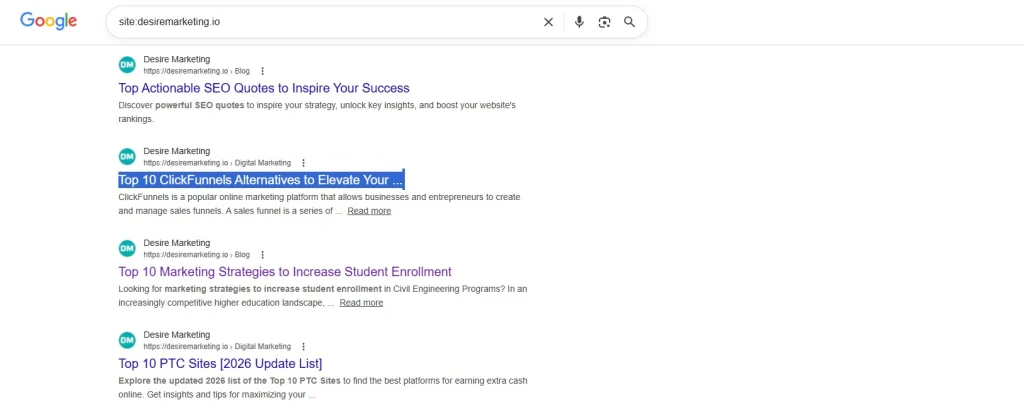
    • Another manual approach is to use type site:example.com into Google to see a list of indexed pages. From the results, pick a page, such as a blog post or product page, and try to locate it on your website.Screenshot of Google search results for Desiremarketing indexed pages

    Start from your homepage and follow these steps:

    • Check the main menu (navigation bar) and browse through relevant sections like blog, services, or products
    • Use the internal search bar, if available, to search for the page title
    • Open the relevant category or listing pages and scan for the page
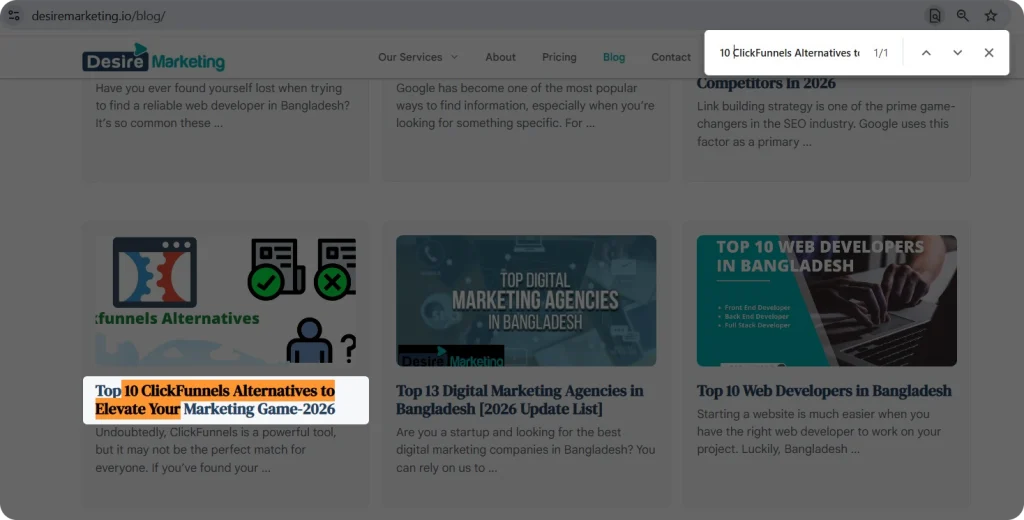
    • Use the Ctrl + F (or Cmd + F) shortcut on those pages to quickly search for the titleScreenshot of Google search results for Desiremarketing indexed pages

    If you cannot find the page through normal navigation or search, it may be an orphan page or a page with very weak internal linking.

    Note: Since these methods rely on manual checking, they are best used to identify potential orphan pages rather than provide a complete and fully accurate list.

    • Using SEO Tools

    Now, if your website is much bigger for a manual check and the page structure is more complex, you can use professional SEO tools to find orphan pages. Tools like Ahrefs, Screaming Frog, or Semrush are among the most popular ones to help you with this task. 

    Let’s see how Ahrefs Site Audit can help you find orphan pages on your website.

    First and foremost, you need to set up an Ahrefs account. After logging in to your account:

    • Go to the Site Audit section and follow the instructions to run a new audit project. This is a great tool to run scheduled SEO audits on your website.
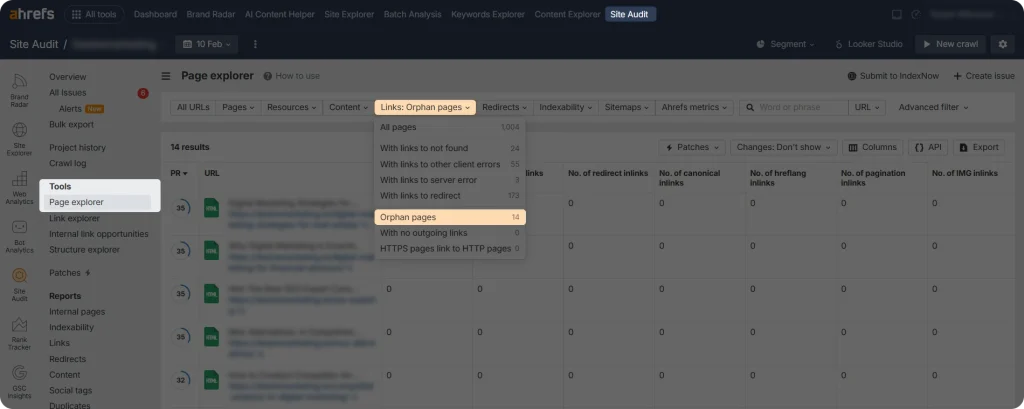
    • After the audit is completed, go to Tools > Page Explorer
    • In the Links filter, hit Orphan pages to see the list of orphan pages on your website that Ahrefs has managed to identify.Screenshot showing how to find orphan pages on Ahrefs Site Audit

    Note: These are only the pages included in your sitemap or that have a backlink profile. Otherwise, Ahrefs doesn’t have the data on your orphan pages (and neither does Google.)

    • Fixing Orphan Pages

    As mentioned, orphan pages are pages that have no internal links pointing to them from other parts of your website. The most logical way to fix them is to add at least one relevant internal link.

    However, depending on the type of page, its further importance, and how it was created, there are other ways to handle orphan pages as well.

    So, here are some of the most common solutions to fixing orphan pages:

    • Adding internal links: Make sure to add at least one relevant internal link pointing to your orphan page. Ideally, link to it from pages with organic traffic or closely related in topic, such as blog posts, category pages, or your homepage. Use clear, descriptive anchor text so both users and search engines understand what the page is about. If the page is important, consider adding multiple internal links to improve its visibility and accessibility.
    • Redirecting: If the orphan page is no longer needed or contains outdated information, consider redirecting it to a more relevant, updated page using a 301 redirect. This is especially important if the page has backlinks, as redirects help preserve the SEO value instead of losing it.
    • Deleting: If the orphan page no longer provides value, has no backlinks, and is not needed for your website, deleting it can be the best option. This helps keep your site clean and focused, without unnecessary pages.

    Additionally, make sure to conduct regular site SEO audits to identify not only orphan pages but also other SEO issues on your website. Addressing these problems early can help improve your site’s overall performance in search engine results. 

    Final Thoughts

    Website maintenance should be a top priority if you want your site to perform well online, and preventing orphan pages is an important part of that process. Once you understand how to find orphan pages, the rest comes down to consistent planning.

    With a well-structured internal linking strategy and proper use of redirects, you can prevent orphan pages from appearing and ensure your website structure stays easy to navigate for both users and search engines.

  • 5 SEO Audit Services for Your Website Success

    5 SEO Audit Services for Your Website Success

    Picture this: your website is not performing well online, and you are not sure what is causing the problem. It could be site speed, content quality, or even the overall site structure.

    This is where SEO audit services come in. They help identify issues on your website and provide clear guidance on how to fix them.

    If you do not have the technical knowledge or experience to carry out an audit yourself, it is often better to rely on specialized services. To help you choose the best option for your business, in the article below, we have offered the most popular SEO audit providers you can explore.

    What is an SEO Audit?

    An SEO audit is an analysis of a website to identify issues that may be limiting its ranking potential. It also helps create a clear roadmap for fixing these problems and improving the website’s performance in search engine results.

    Generally, an SEO audit includes key areas such as:

    • On-page SEO audit: Here, your main goal is to check and fix all the internal issues within your website, such as meta tags, internal links, and the overall website content. Using an AI SEO tool can help identify on-page issues more efficiently by analyzing meta tags, internal linking structures, content quality, and other optimization opportunities across your website.
    • Off-page SEO audit: You check external backlinks pointing to your website, including any lost or broken backlinks.
    • Technical SEO audit: In this phase, you check the technical aspects of your website, such as its speed, mobile-friendliness, and overall site performance.

    And if you are wondering why you should do an SEO audit, here are the core reasons:

    • Finding and fixing issues that are blocking your website from ranking higher on search engines
    • Maintaining strong site performance and a smooth user experience
    • Monitoring your website’s overall online performance over time
    • Analyzing your website’s performance against competitors, identifying gaps, and addressing them

    So, an SEO audit is an important step you should not skip if you want your website to deliver a smooth user experience, have strong ranking potential, and perform effectively overall. Modern SEO audits also take into account SEO and AI-driven search, ensuring your website is optimized not only for traditional ranking factors but also for evolving AI-powered search experiences and intent-based results.

    SEO Audit Services: 5 Options to Consider

    There are thousands of SEO audit services available, each offering different features, scopes of work, and pricing structures.

    Here are five popular agencies you can consider:

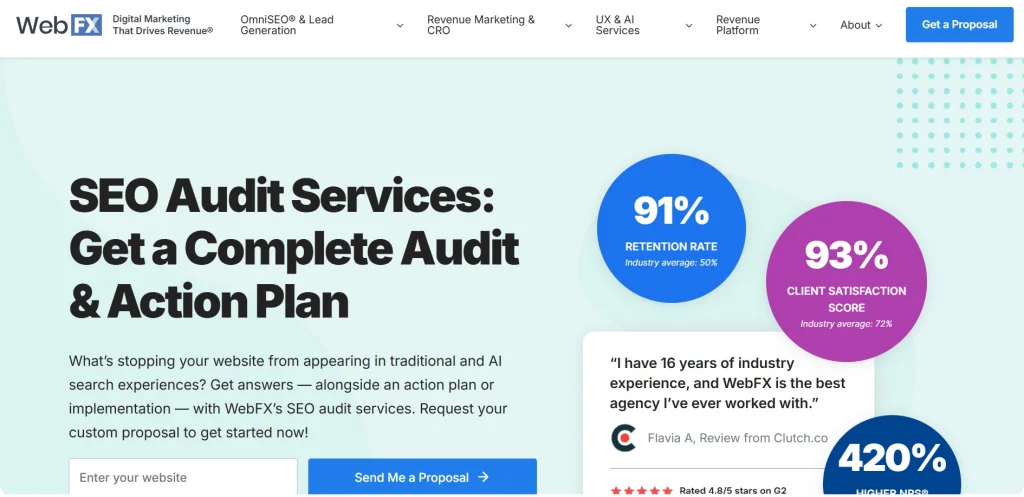
    WebFXScreenshot of WebFX website SEO audit services section

    WebFX is a digital marketing agency with over 25+ years of experience in the industry. WebFX provides data-driven marketing services that focus on improving online visibility, lead generation, and conversions. 

    One of their core services provided is SEO audit services, which covers the following areas:

    • On-page SEO audit
    • Off-page SEO audit
    • Technical SEO audit
    • AI SEO audit
    • SEO report
    • Audit implementation
    • SEO strategy
    • Pricing:

    WebFX offers custom SEO audit plans starting at $8,600/ month. Pricing depends on each website’s SEO needs and website size.

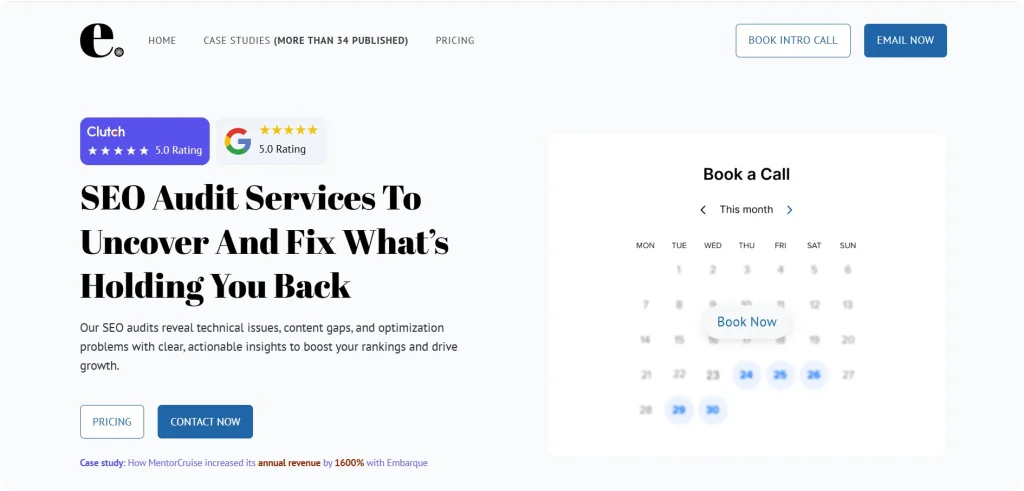
    EmbarqueScreenshot of the Embaruqe website SEO audit services section

    Embarque is an SEO and AI-driven search agency that helps businesses grow through organic search. The company provides services like technical SEO, content strategy, and SEO link building, all designed to increase traffic, generate leads, and drive revenue. 

    At the same time, Embarque’s SEO audit services are designed to reveal the website’s technical and content gaps and provide actionable recommendations to fill them and boost rankings. 

    Among the core areas covered within the audit services are:

    • Technical SEO audit
    • On-page SEO audit
    • Topical authority audit
    • Backlink profile audit
    • UX and core web vitals audit
    • Pricing:

    Pricing plans depend on the scale of services provided.

    • Tier 1: $2,799/ month (includes content creation, Backlinks, Account management, Revenue-based strategy & tracking, GMB listing optimization, Localized directory listings inclusion, Basic optimisations, Monthly reports)
    • Tier 2: $4,900/ month (includes everything in Tier 1 + heatmap tracking, AI/LLM SEO, Reddit, and forum marketing)
    • Tier 3: $5,999/ month (includes all tier 2 services + Programmatic SEO, Technical SEO, Multilanguage SEO)
    • Enterprise: Starting at $11,000/ month (includes every tier 3 capability + A/B testing, full-funnel analytics integration, Programmatic SEO, Multilanguage SEO)

    For further information on audit services tailored to your specific needs, you can contact Embarque’s team via email directly from their website.

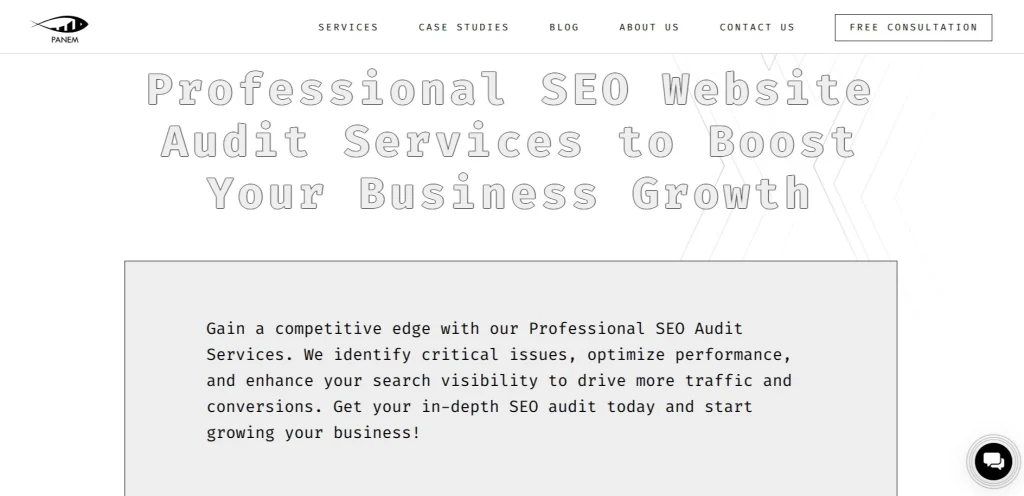
    Panem Agency

    Panem Agency is a full-service SEO and digital marketing agency, working with clients across the US, EU, and Canada. It specializes in SEO, PPC, content strategy, and AI-driven optimization for international brands. 

    Panem Agency also provides SEO audit services, encompassing areas such as:

    • Usability analysis
    • Keyword analysis
    • Content optimization
    • Technical analysis
    • Domain analysis
    • Google penalties
    • Competitor analysis
    • Backlink audits
    • Local SEO audit
    • Pricing:

    Panem Agency offers 3 pricing plans, depending on the services provided.

    • Essential SEO audit: Best for small businesses or startups looking for a foundational SEO check-up, from $500
    • Advanced SEO audit: Growing businesses needing an in-depth analysis of technical SEO, content, and rankings, from $1000
    • Premium SEO audit and strategy package: Enterprises and businesses requiring a comprehensive, data-driven SEO strategy with a roadmap for long-term growth, Custom pricing based on project scope

    Panem Agency allows you to get a free consultation directly from their website to get a deeper understanding of their services.

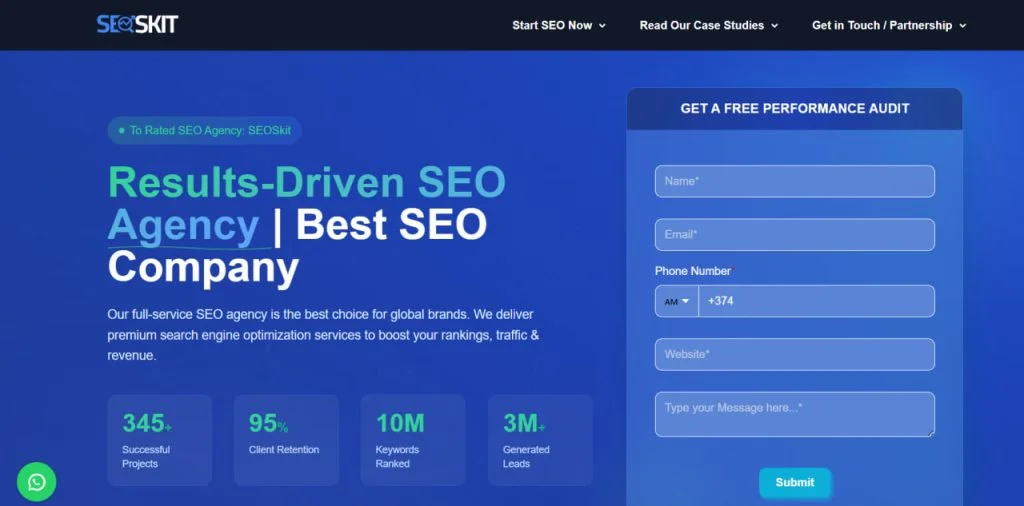
    SEOSkit

    Screenshot of the SEOskit website SEO audit services section

    SEOSkit is an SEO agency that provides search engine optimization services for businesses looking to improve their online visibility and organic traffic.

    It offers services such as SEO audits, technical optimization, keyword research, on-page SEO, link building, content strategy, and guest posting to help websites improve their rankings.

    Some of the key SEO audit services that the agency offers include:

    • Technical SEO analysis
    • On-Page SEO Evaluation
    • Site Speed Assessment
    • Mobile Responsiveness Check
    • XML Sitemap Review
    • Robots.txt Configuration Analysis
    • Basic Backlink Profile Overview
    • Complete Backlink Profile Audit
    • Comprehensive On-Page Audit
    • Core Web Vitals Deep Dive
    • Pricing:

    The agency offers 3 pricing plans depending on the scope of audit services provided.

    • Basic SEO audit: One-time comprehensive analysis, $499/ audit
    • Professional SEO audit: In-depth analysis with action plan, $999/ audit
    • Enterprise SEO audit: Complete analysis with ongoing support, $2999/ audit

    If you need further information, you can both contact the agency through their website and book a consultation to ask your questions.

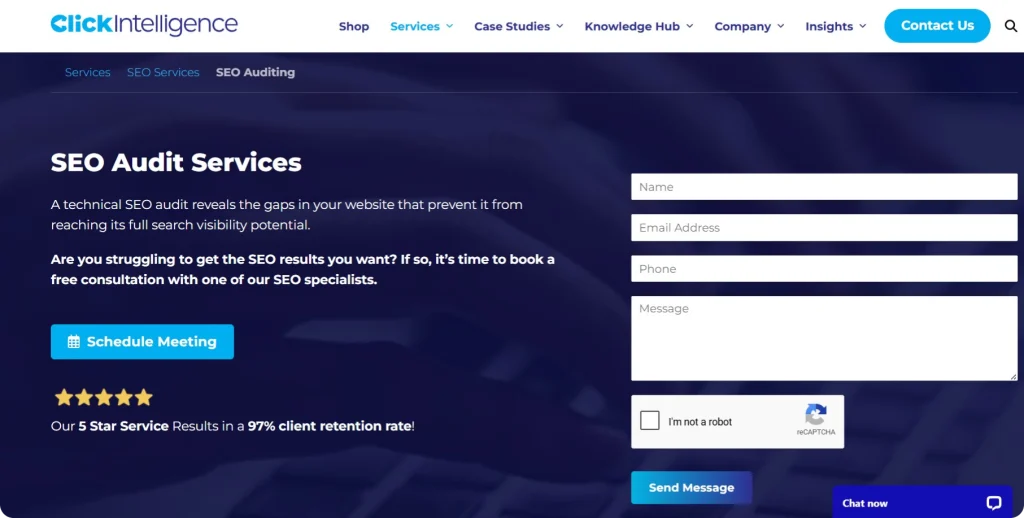
    Click Intelligence

    Screenshot of the Embaruqe website SEO audit services section

    Click Intelligence is a UK-based SEO and digital marketing agency that provides a range of SEO services, including technical SEO audits, keyword research, content optimization, and link building.

    Its audit services focus on areas such as:

    • Keyword Research
    • Technical SEO
    • Technical Audit
    • Content Optimization
    • Backlink Analysis 
    • Pricing:

    There are 3 SEO audit service pricing plans that vary by the services provided.

    • SEO Audit Basic: Designed for startups, from $1,147 – $2,025/ audit
    • SEO Audit Standard: Designed for SMEs, from $2,700 – $6,750/ audit 
    • SEO Audit PRO: Designed for growing enterprises, from $8,100 – $10,800/ audit

    To get more information on the SEO results and audit services, you can send a message to Click Intelligence directly through the website or book a consultation with agency experts.

    How to Choose SEO Audit Services?

    Now that you understand the importance of SEO audit services and have shortlisted a few of them to consider, here are some tips to keep in mind when planning your collaboration.

    • Check agency expertise: Choose an agency with rich experience and background, especially in multiple industries. Make sure they have worked within your industry and can quickly adapt to your specific needs.
    • Ask for case studies: To evaluate their expertise and quality of work, ask for previous projects, case studies, or client testimonials to understand how they have handled similar work. Pay close attention to timelines, results achieved, and the industries they have worked in. It is also important to review their website carefully for additional insights and information.
    • Clarify pricing: Although the pricing plans are usually available on agency websites, the costs of audit services may still vary depending on specific cases and the needs of each client. So, make sure to clarify the final pricing for your website and project. Include it in the final contract to avoid hidden costs and misunderstandings.
    • Clarify communication and reporting: Clear communication is key to any successful collaboration. Make sure you understand which channels will be used, how often updates will be shared, and how reports and deliverables will be provided throughout the project.

    Remember that choosing the right agency is a key step toward achieving your desired results in website marketing and long-term online success. Take the time to research your options thoroughly, clarify all details, and ask the right questions before making a decision.

    Summing Up

    A full SEO analysis is an integral part of your digital marketing efforts. It is a detailed and thorough process, which is why many businesses choose to outsource SEO audit services.

    While there are many providers available, this list of five agencies offers a helpful starting point. 

    With careful research and clear communication, you can find the right partner to ensure the results meet your expectations.

  • 6 Factors That Contribute to Successful New Product Development

    6 Factors That Contribute to Successful New Product Development

    Every product starts with an idea. Sometimes it’s a spark in a meeting room. (Other times, it’s a late-night thought scribbled on a napkin.)

    But turning that idea into a product people love and buy is where the real work begins. 

    The product development process can be unpredictable and full of tough calls. Yet some companies make it look effortless. So, what’s their secret?

    They build connected teams and invest in people just as much as in the process. They also treat product development as a continuous learning and adaptation system.

    Let’s take a closer look at what today’s top-performing product developers do differently. 👇

    Key Pillars To Successful New Product Development

    Product development suffers from too many moving parts pulling in different directions. 

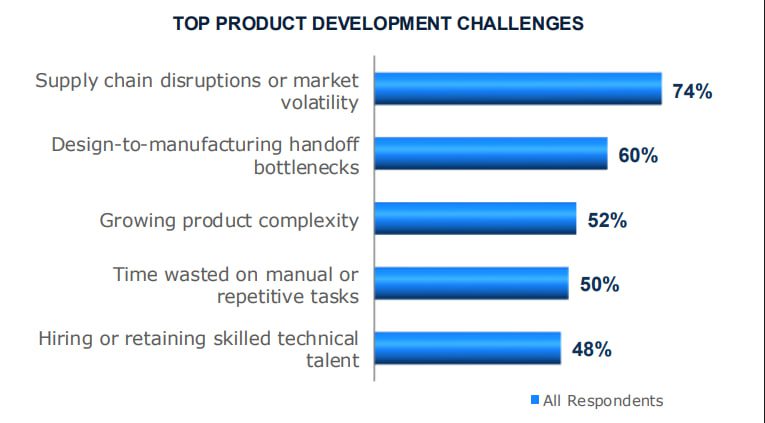
    According to Tech-Clarity’s 2025 State of Product Development report, the top product development challenges include supply chain disruptions and process bottlenecks between design and manufacturing. 

    Screenshot from solidworks.com articlr

    (Image Source)

    Top-performing teams do things differently to overcome these challenges. 

    They focus on fundamentals such as clear communication and continuous feedback. This keeps the product development process moving smoothly from idea to launch.

    Here’s how you can follow suit. 👇

    1. Understand Your Customers First

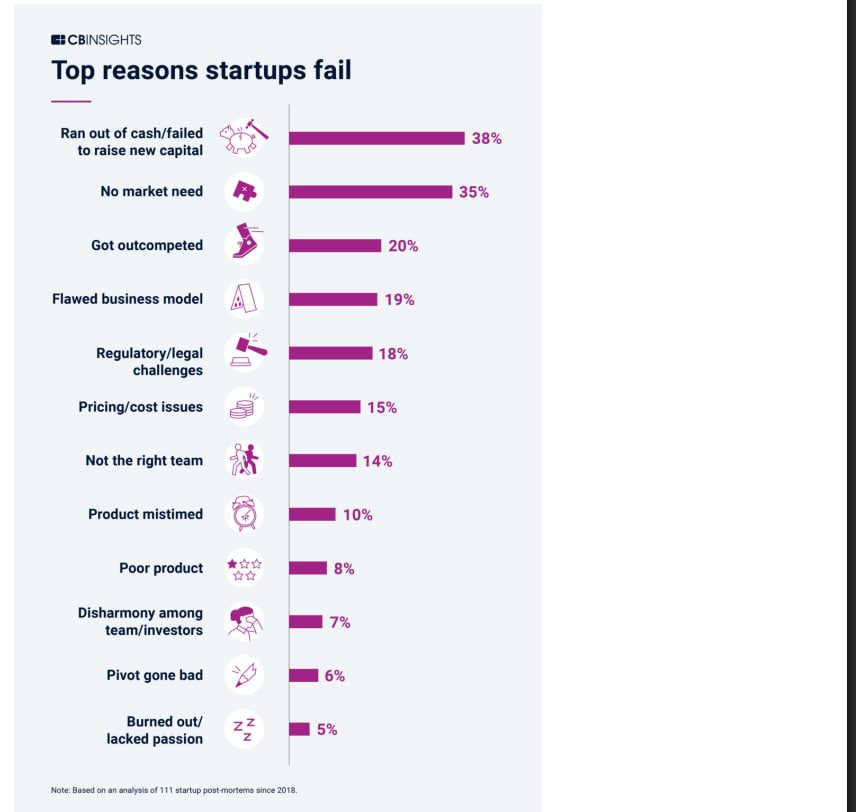
    According to CB Insights, the second biggest reason startups fail is that there’s no market need for their product. In other words, they never truly understood their target market. (And this is why market research is important)

    Screenshot of cbinsights.com

    (Image Source)

    Top Reasons Startups Fail

    But knowing your audience is the first step toward building something people want.

    And the best place to start? Look at what people are searching for. 

    Keyword research is your cheat sheet to customer intent. It shows you what they want, what they’re comparing, and what’s missing from the market.

    Then go deeper. Social listening tells you how people feel about products like yours. You’ll find their frustrations, favorites, and unfiltered opinions. Combine that with your own customer data, and you’ll see patterns.

    Finally, test those ideas before you scale. Launch a minimum viable product (MVP), collect customer feedback, and let real data steer your product innovation. This is where a Product Owner plays a critical role by aligning stakeholders, development teams, and business objectives to keep product initiatives moving in the right direction.

    After you know who you’re targeting and what they want, it’s much easier to build something your potential lead list cares about.

    2. Build Bridges Across Teams

    Product-Led Alliance’s 2025 State of Product Ops report found that 24% of product teams struggle with cross-department alignment. This is a major problem, since collaboration is what separates top performers from everyone else. 

    When everyone’s on the same page and has the same resources, work moves faster and more accurately. 

    Collaborations also help spot issues earlier and solve problems before they slow down the product development process. 

    For example, when product design and manufacturing teams share real-time updates, they can catch material or dimension changes instantly and prevent weeks of changes.

    To achieve better alignment between teams, make sure to have shared tools and transparent workflows. You might also need to host a collaboration training day to show departments how to work together successfully. 

    3. Let Future-Forward Technology Do the Heavy Lifting

    AI is fast becoming a significant part of research and development across all industries. Product development is no different.

    In fact, Tech-Clarity found that top product development teams are nearly twice as likely to use AI tools as others. 

    And for good reason. From generative AI that designs early prototypes to machine learning models that predict demand, AI models free teams from repetitive work and open creative bandwidth.

    On top of AI, top product developers are using simulations to test products. Teams can run thousands of virtual experiments before ever touching production. 

    Screenshot from technia.com

    (Image Source)

    As Tech-Clarity found, 99% of the companies using these tools say it’s improved testing since it reduces physical prototypes and increases efficiency.

    4. Streamline the Product Development Workflow

    If your product development process feels chaotic, you’re not alone. 

    The Product-Led Alliance found that 40% of teams believe streamlining workflows would solve most of their issues.

    This is where product lifecycle management (PLM) systems are immensely helpful. They help you standardize how work moves through each stage. (From the fuzzy front end of ideation to market launch and beyond.)

    Everyone follows the same structure, reducing confusion and making handoffs between teams quicker and cleaner.

    5. Invest in Your People and Culture

    Even the best product process will fail without strong teams behind it. The problem is that nearly half of the teams struggle to hire or retain skilled technical talent. (See the first chart above.)

    Improving this starts with hiring for potential, not solely credentials. You need to look for people who learn quickly, thnk creatively, and collaborate well. You also need to build clear career paths so top performers see a future with your company.

    But hiring is only half the picture. 

    You also need to empower the people you already have. The top organizations invest in continuous learning, mentorship, and collaboration tools that improve knowledge and make it easy to share. 

    6. Measure, Learn, Repeat

    After market launch, be sure to gather customer feedback, monitor the user experience, and track performance metrics. This continuous data loop is the engine of product optimization, allowing you to refine features and fix friction points before they drive users away.

    This evaluation process shows you where you can adapt and improve, so you can strengthen the product life cycle and build long-term customer success.

    Wrap Up

    The best product development teams rely on data, collaboration, and reiteration. 

    But this all starts with doing market research to understand your audience so you’re building products they want. 

    This is why you need an agency that understands search from every angle.

    Desire Marketing is the partner you’ve been looking for. We use search insights and data-driven storytelling to help you fully understand your audience, so every product idea starts with real customer demand.

    Get in touch today to learn how to turn your next great idea into a product people can’t wait to discover and have a successful business growth.

  • SaaS Growth Engine: The Architecture of Scalable Modern SaaS

    SaaS Growth Engine: The Architecture of Scalable Modern SaaS

    In the current software-as-a-service landscape, the barrier to entry has never been lower, but the barrier to scale has never been higher. Most SaaS founders and marketing leaders operate in silos; the product team focuses on efficiency, the marketing team on acquisition, and the finance team on cost management. 

    However, true market leaders understand that sustainable growth is a byproduct of a unified ecosystem where data flows seamlessly between operational tools and growth strategies.

    To survive the “SaaS plateau,” companies must move beyond basic subscription models and embrace a sophisticated tech stack that prioritizes visibility, precision, and automated intelligence.

    Unifying Growth, Data, and Revenue Operations

    Part I: Building the Core Growth Stack

    Data-Driven Relationship Management

    At the heart of every successful SaaS enterprise is a robust system for tracking user behavior and lifecycle stages. Managing thousands of concurrent users requires more than a simple spreadsheet; it demands a centralized hub where every interaction — from the first sign-up to the latest support ticket – is logged. 

    When a CRM is properly integrated into the product backend, it allows for hyper-personalized messaging and automated churn intervention, ensuring that the cost of acquisition is eventually outweighed by the lifetime value of the customer. Similar principles of HR automation can streamline internal workflows and improve overall organizational efficiency.

    The Foundation of Search Visibility

    While paid ads offer a quick spike in traffic, organic search remains the most cost-effective long-term growth lever for B2B software. However, modern search engines demand more than just keyword-stuffed blog posts. Sites must be fast, crawlable, and architecturally sound. 

    Partnering with a specialized technical SEO agency ensures that your platform’s infrastructure supports your content efforts, fixing issues like JavaScript rendering, Core Web Vitals, and complex site migrations that often plague growing SaaS domains.

    Operational Intelligence and Efficiency

    Scaling a SaaS business often introduces “organizational debt” — inefficient workflows that slow down product releases and customer onboarding. Identifying these bottlenecks manually is nearly impossible in a remote or hybrid environment. 

    Utilizing process mining software allows leadership to visualize actual workflows based on event logs, highlighting exactly where tasks are stalling and where automation can be applied to streamline the path to revenue.

    Advanced Measurement and Attribution

    As marketing budgets face increased scrutiny, “last-click” attribution is no longer sufficient to prove ROI. SaaS companies often use a mix of content, social proof, and performance ads. 

    Implementing mmm marketing (Marketing Mix Modeling) provides a holistic view of how various channels interact. By using statistical analysis to account for external factors and non-digital touchpoints, leaders can allocate budgets more effectively, ensuring that every dollar spent contributes to incremental growth rather than just cannibalizing organic leads.

    Optimizing the Supply Chain of Software

    Efficiency isn’t just about how you sell; it’s about how you spend. As SaaS companies grow, their own internal “tool bloat” can become a significant financial drain. 

    Integrating AI procurement software into the finance workflow helps teams manage vendor relationships, negotiate better contracts, and eliminate redundant subscriptions. This level of automated oversight ensures that the company remains lean and that capital is preserved for R&D and market expansion.

    The New Standard of Output

    Finally, the speed of development is the ultimate competitive advantage in software. The integration of artificial intelligence into the developer workflow has shifted the baseline for what a small team can achieve. 

    Prioritizing AI productivity within engineering and marketing departments allows for faster shipping cycles and rapid content iteration. When teams spend less time on repetitive syntax or basic formatting, they can focus on high-level architecture and creative strategy — the real drivers of long-term brand equity.

    For SaaS teams that also need to unify tasks, calendars, meetings, messages, and follow-ups across multiple apps, an all-in-one productivity tool like Akiflow can centralize daily execution, reduce context switching, and help teams stay aligned as they scale.

    Part II: Scaling Beyond the First $10M ARR

    Scaling the Human Element in an Automated World

    While the tools and frameworks above provide the structural integrity needed to reach the first $10M in Annual Recurring Revenue (ARR), the transition to $100M requires a shift from managing tools to managing ecosystems. In this phase, the data generated by your internal systems becomes your most valuable intellectual property. 

    The challenge for modern leadership is ensuring that the influx of automation does not lead to a “black box” culture where decisions are made by algorithms without human oversight. Instead, the goal should be “augmented intelligence” – where the technical stack handles the cognitive load of data processing, freeing up human talent to solve complex architectural problems and cultivate deep-market empathy.

    The democratization of high-level analytics means that even seed-stage startups can now access the same caliber of insights once reserved for enterprise giants. However, this accessibility creates a new kind of competition: the race for execution speed. It is no longer enough to have the best data; you must have the shortest path from “insight” to “action.” This is where the integration of your growth stack becomes critical. If your marketing models aren’t talking to your procurement systems, or if your technical SEO audits aren’t influencing your product roadmap, you are leaving money on the table through “fragmentation friction.”

    The Ethics of Algorithmic Growth

    As we lean further into AI-driven operations, SaaS companies must also navigate the burgeoning field of digital ethics. Transparency in how data is utilized, not just for the end-user, but within internal operations, builds a culture of trust that is vital for talent retention. 

    When employees understand that tools are being implemented to enhance their capabilities rather than replace their roles, the adoption rate of new technologies skyrockets. This cultural alignment is the “secret sauce” that allows some SaaS companies to pivot and adapt with agility, while others remain stuck in legacy mindsets.

    Building a Composable, Future-Ready Architecture

    Looking toward the next decade, the “composable SaaS” trend suggests that the most successful platforms will be those that play well with others. The ability to integrate seamlessly with a client’s existing stack is a primary selling point. 

    Therefore, maintaining a clean technical foundation and a flexible data architecture isn’t just an internal preference, it is a core product requirement. By investing in the backend today, you are essentially pre-paying for the flexibility you will need to dominate the market tomorrow.

    Part III: Navigating Market Volatility and the Long Game

    Efficiency as the Only True Hedge

    The volatility of the global economy has taught us that efficiency is the only true hedge against uncertainty. In a “growth at all costs” era, waste was often overlooked. In the current “growth at an efficient cost” era, every redundancy is a risk. This shift in philosophy is why the convergence of marketing, operations, and finance tools is so pivotal. 

    When you can see a direct line from a technical site fix to a lead in your database and then to a closed-won deal reflected in your modeling — you gain the confidence to double down on what works and cut what doesn’t with surgical precision.

    Ultimately, the SaaS companies that will define the next generation are those that treat their operational stack as a product in its own right. It requires constant iteration, bug fixes, and feature updates. By viewing your business as an interconnected organism powered by data and refined by AI, you move beyond the limitations of traditional software management and into a realm of sustainable, scalable, and highly profitable innovation.

    Conclusion: Building for the Long Term

    The future of SaaS is not found in a single “silver bullet” feature, but in the orchestration of various specialized systems. By aligning technical foundations with intelligent data analysis and modern procurement practices, companies can build a growth engine that is both resilient to market shifts and primed for exponential scaling. The goal is to move from a collection of tools to a unified platform that works in harmony to serve both the business and the end-user.

  • How to Improve Domain Authority: Core Tips Reviewed

    How to Improve Domain Authority: Core Tips Reviewed

    Have you ever received outreach emails saying “get backlinks from websites with high DA” or “DA 30+”? Or noticed that your potential link partners lose interest because your site’s authority seems too low?

    This often leads to a common question: how to improve Domain Authority to unlock better link building opportunities and strengthen your site’s overall SEO performance?

    If you are new to SEO and link building, this guide will help you understand what Domain Authority is, why it matters in link building, and the most effective steps to improve it.

    What is Domain Authority?

    Domain Authority is a metric (or a relative score) developed by Moz to evaluate a website’s potential and competitiveness on SERPs. Although it is widely used by digital marketers and business owners, it is not an official Google ranking metric.

    Domain Authority score can change over time, and various factors affect these changes, such as:

    • Changes in your backlink profile (losing or getting backlinks)
    • Changes in your competitors’ backlink profile
    • Search engine algorithm changes

    Since DA was developed by Moz, it is calculated using data from its Link Explorer index, taking multiple factors into account.

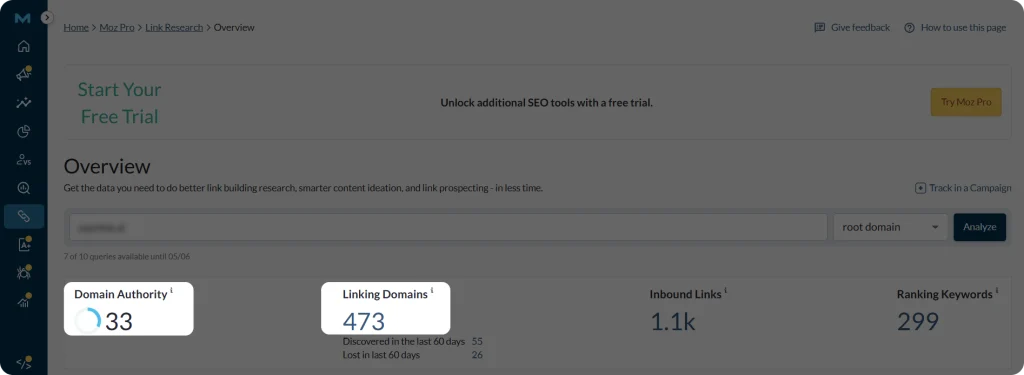
    • To check your Domain Authority, go to Link Explorer and type your domain URL
    • You’ll see a general overview of your website metrics with DA and Linking Domain numbers (number of unique external sources that link to you), too. Screenshot of Moz Overview section
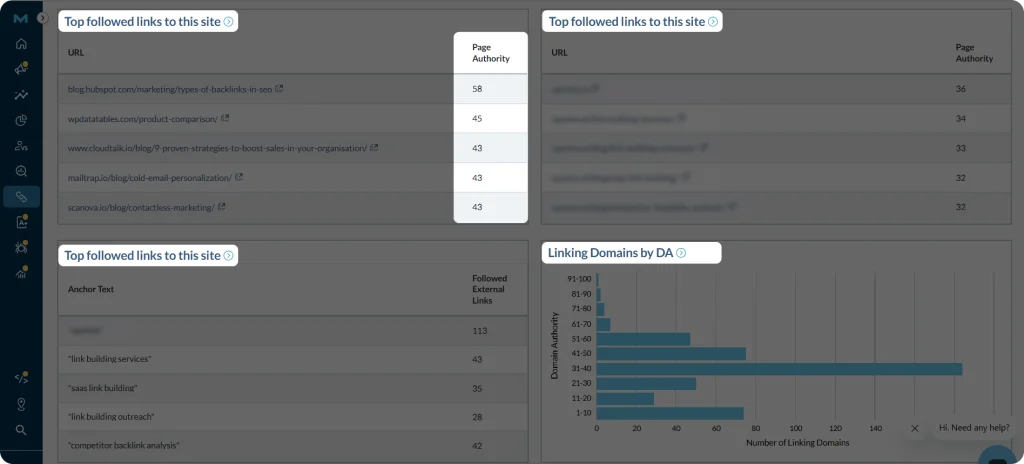
    • Later as you scroll down, you can see 4 sections showing the pages that link to you (“top followed links to this site”), your pages, that are linked to (“top pages on this site”), your anchor texts (“top anchor texts for this site”), as well as a chart sorting linking domains by their DA.Screenshot of Moz Overview section

    You might have also heard of Domain Ranking, which is also a website authority metric, but created by Ahrefs. 

    • Domain Authority: Created by Moz. The scale is from 0 to 100. The goal is to predict how likely a website is to rank on SERPs 
    • Domain Ranking: Created by Ahrefs. The scale is from 0 to 100. The goal is to evaluate the strength of a website’s backlink profile

    So, in short, Domain Authority is a relative metric that compares your site’s ability to rank on search results against competitors, making it most useful for understanding your ranking potential within your industry.

    Why Do You Need to Improve Domain Authority?

    If Domain Authority is a relative metric and not used by Google, a natural question arises: why should you care about improving it?

    While it is not an official ranking factor, DA score is still widely used by SEO professionals and businesses as a practical benchmark.

    • To earn backlinks from higher-quality websites: Many SEO and link building specialists use DA scores as a quick filter when deciding whom to collaborate with and how to further coordinate their manual link building efforts.
    • To understand your competitiveness: Since it is a comparative score, it helps you see how your website compares to others in your industry.
    • To shape your SEO strategy: By knowing where you stand and collecting your backlink data, you can set realistic goals and focus on actions that improve your overall search performance.

    For these reasons, the DA score is still used to understand how strong a website is, especially when building links and comparing it with competitors.

    So, How to Improve Domain Authority? 

    Now that you have a general understanding of Domain Authority, how and why it is used in SEO, let’s discuss some important steps to improve your DA.

    Get Links from Authoritative Websites 

    Since Domain Authority is calculated based on backlink data, it means that the primary way to improve your DA is to acquire backlinks from authoritative websites. 

    Backlinks are important for any website’s online presence. Earning natural backlinks is one of the most important SEO strategies for improving visibility and authority.

    Don’t try to buy backlinks or use other black-hat practices, as those will harm your rankings. Instead, try to identify relevant and authoritative websites and reach out for a backlink exchange.

    One good option is researching which websites link to your competitors and not to you. 

    Here, Moz can help you.

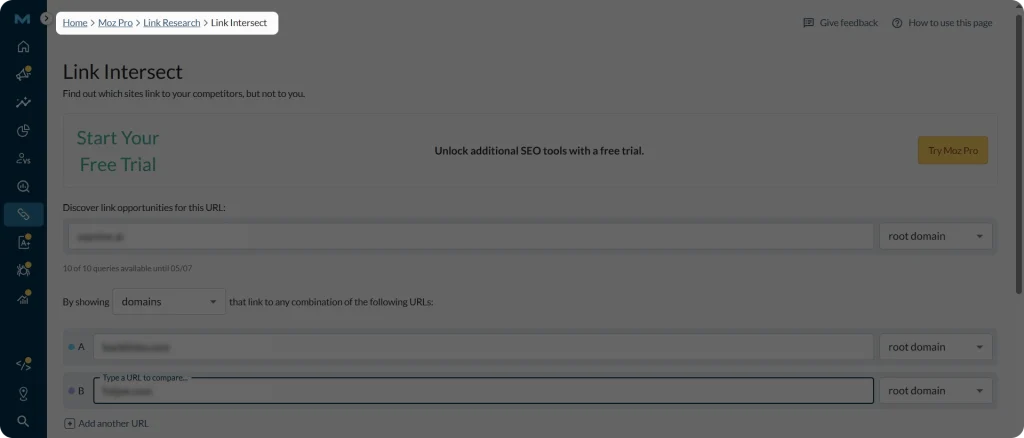
    • Log in to your Moz account (for deeper insights, you need to have a Moz Pro subscription)
    • Go to the “Link Intersect” section.
    • Enter your URL and then your competitors’ URLs and hit “Find opportunities”. Screenshot of Moz Link intersect section

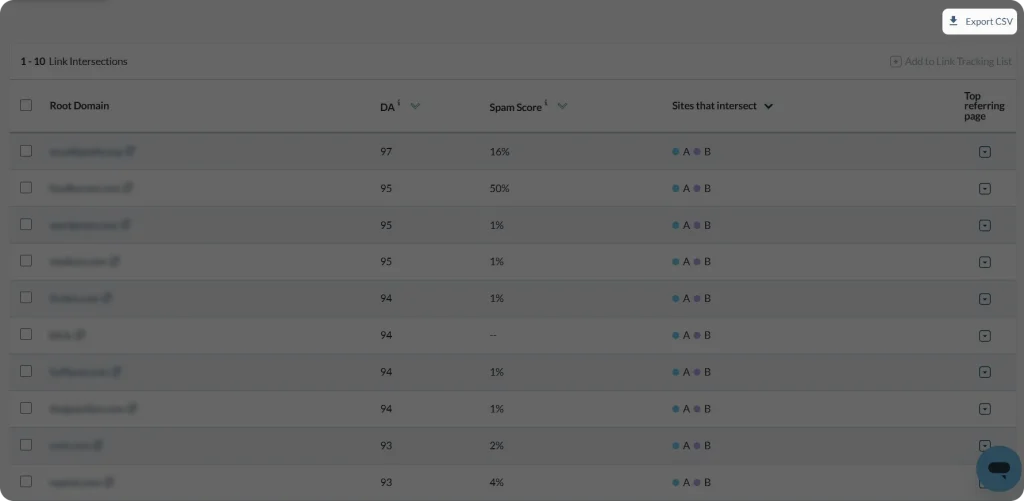
    There you go, a list of all the potential link building sources is presented.

    Screenshot of Moz Link intersect section

    You can then download this list in a CSV format for your further analysis and filtering. Pay special attention to DA scores by sorting the ones that are higher.

    After filtering all the relevant websites, find contacts and reach out for backlink opportunities.

    Create Content Worth Linking to

    Another reliable way to get backlinks is to create compelling content that will add value to the target website, your target audience, and search engines in general.

    Don’t just generate robotic content that is stuffed with keywords. Instead, invest some time in keyword and topic research to create content that is built around people’s search queries. Make sure your keywords are relevant and fit the context without overloading your article.

    Here are some tips along the way:

    • Use a simple Google search to see what people are searching for. On Google, type your seed keywords (like “digital marketing”, “SEO strategy”, “SEO content writing”) and the most popular related search queries will show up. For long-tail results, scroll down to the “People also search for” section.
    • This will help you understand the type of content your audience prefers, whether it is informational blog posts, in-depth guides, or case studies.
    • For deeper insights, use SEO keyword research tools like Ahrefs, Semrush, or Moz. All these listed tools have free keyword research tools to uncover general keyword insight. However, if you want to go deeper, different pricing plans are available, depending on your business needs.

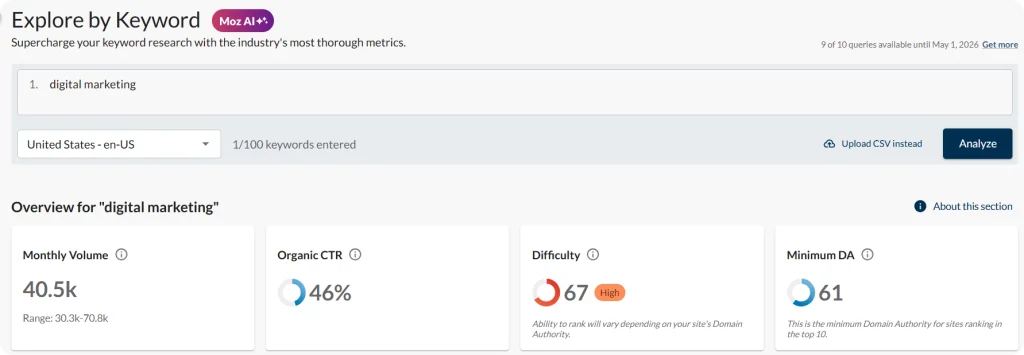
             Let’s take a look at Moz Keyword Explorer, as an example. After searching for your seed keywords, you get an overview of your           keywords’ search volume, difficulty, or primary search intent.

    Screenshot of Moz Keyword Explorer section

    • As you scroll down, you can uncover more keyword suggestions and questions related to your general keyword, again, with respective metrics showing too.Screenshot of Moz Keyword Explorer section and top keyword suggestions

    When creating your content, also pay attention to your article structure, making sure it’s clear and readable.

    In short, your content should be valuable, relevant, and genuinely worth linking to, making it a strong foundation for successful organic link building efforts.

    Don’t Forget About On-Page SEO 

    While you may be putting a lot of effort into finding and reaching out to websites for backlinks, it is just as important to make sure your own website is worth linking to and visiting. This means having solid on-page SEO in place to deliver a smooth and reliable user experience.
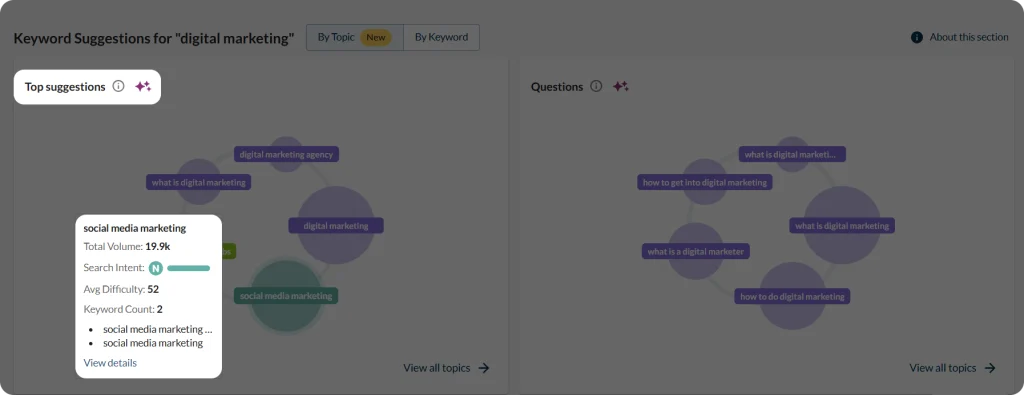
    If your site is slow, hard to navigate, or poorly structured, even high-quality backlink opportunities may not convert:

    • Choose the right primary and secondary keywords, and use them naturally throughout your content, especially in titles and headings
    • Add internal links to help users navigate easily across your website
    • Use schema markup to help search engines like Google better understand your content
    • Ensure your website loads quickly, is mobile-friendly, and has no broken pages

    Ensuring smooth navigation, fast load times, and proper keyword usage improves the user experience, strengthens your website’s credibility in the eyes of users and search engines, and can therefore contribute to higher Domain Authority.

    To Sum Up

    You can think of Domain Authority as a score from 0 to 100 that shows how strong a website is compared to others in terms of SERP ranking potential.

    While it is not a direct measure of ranking success, it can still help you get a quick idea of your backlink profile and guide your link building efforts, especially when learning how to improve Domain Authority.

    By focusing on getting high-quality, relevant backlinks and creating useful content, you can slowly improve your website’s authority and support better long-term SEO results.

  • SEO Writing: How to Make Your Content Shine Online

    SEO Writing: How to Make Your Content Shine Online

    Let’s picture this: you spent hours researching your topic and writing a top-notch article. You feel relaxed after finally publishing it. But time passes, and your article is not doing so great on SERPs.

    So you start questioning whether your piece was good enough. The thing is that the problem may not be in the content itself, but the SEO strategies that you might have missed while writing your article.

    To do well on SERPs, you need to master the SEO writing tips and tricks.

    And this article provides just that, so read along to find out more.

    What is SEO Writing?

    SEO writing is the process of writing and optimizing your content so that it ranks well on search engines and attracts traffic. It also helps your content get featured on AI search engines, too. Various optimization rules are used to achieve this goal.

    This is what makes it different from general content writing. 

    • SEO writing: Here, your content is strategically structured around keywords and search intent. It follows a clear optimization structure. The core goal is to improve visibility on search engines while maintaining readability and value for the reader. 
    • Content writing: The focus is primarily on informing, educating, or engaging the audience. It is more flexible in structure and does not require strict keyword targeting. As a bonus, it can still perform well in search results if the content naturally matches the search intent.
    So, remember that your article should not only answer people’s queries but also be structured in an SEO friendly way. 

    SEO Writing: A Go-To Optimization Checklist

    So, if your goal is to increase your brand visibility through your content, let’s turn to the optimization steps below.

    Optimize Your Article Structure

    One of the most important rules in SEO writing is your article structure. It has to be as clear as possible to ensure readability. 

    Here are some common points you need to consider when structuring your article:

    • Keep your meta titles within 50-60 characters, while meta descriptions within 150-160 characters.
    • Ensure a hook in your meta tags, so that your readers are interested enough to click and open your article.
    • URL slug: Optimize your article URL, too, by making it as short and clear as possible. For example: /seo-writing, /content-writing-tip.
    • Bullet points and numberings: Where relevant, break your idea into bullet points and numberings as these are easier to read visually than long paragraphs, which readers usually tend to skip.
    • Clear paragraphs and sections: Break your articles into paragraphs. Try to present one idea per paragraph without stuffing them. Be short and precise. 

    By ensuring your article is structured, not only people, but also search engines will be able to smoothly scan through your article and grasp which topic is mentioned in which section.

    Identify the Search Intent

    Search intent is the reason behind your users’ searches. Why did they search for that specific term, and what information did they want to get? And to rank higher, your content should match their intent.

    There are 4 main types of search intent:

    • Informational: These types of content (blog posts, articles, guides) help readers to learn something and get new information.
    • Navigational: This is when users want to land on a specific page or website.
    • Commercial: Here, users want to find options, compare them, before actually making a purchase.
    • Transactional: And as a last stage, users are ready to take action, such as buying or subscribing.

    To identify the search intent, you can simply have a closer look at the Google search results and “People also ask” section, because each of the intents has a structure and its specific keywords, which is especially important for local SEO. For example, if the query is “how to” or “what is”, this is an informational intent, while keywords such as “best” or “top” are common for the commercial one.

    Here’s an example of a commercial intent for “keyword research tools”.

    Screenshot of Google search results for commercial intent identification

    Many SEO tools, like Ahrefs, also show the search intent for each matching keyword of your target keyword. Here’s an example of Ahrefs. 

    • Just type your general keyword in the Keyword Explorer, 
    • Go to the Matching terms section,
    • See the letters “I”, “N”, “C”, “T” for each matching keyword.Screenshot of Ahrefs Keyword Explorer for search intent identification

    By understanding the search intent, you will be able to structure your content accordingly, target the right keywords, and ensure appearing in the SERPs at the right time.

    Place Keywords Naturally

    In SEO writing, your content is built around your primary and secondary keywords. To achieve this, you need to do keyword research and identify keywords that have high chances of ranking on SERPs (pay attention to KD and search volume). Tools like Ahrefs, Semrush, or Moz can help you with this research.

    However, this doesn’t mean that adding as many of your target keywords as possible will benefit your rankings. In fact, keyword stuffing will make it even worse and lead to low rankings or not showing on SERPs at all. 

    Nothing new, just Google spam policies.

    Now, if you are asking yourself what the rule of avoiding keyword stuffing is, here are some suggestions:

    • Use keywords once every 200 words in your article. 
    • If they don’t fit in the paragraph or context, just don’t place them. Use synonyms or related terms instead.
    • Make sure your primary keywords are present in your meta tags, Heading 1 (your title), intro, and conclusion (but only once or twice). Place in the subheadings only if relevant.
    • After completing your article, re-read it to identify the sections with keyword overuse, because you might not notice it while writing.

    To sum up, the general rule for avoiding keyword stuffing is to use your keywords evenly and naturally.

    Use Relevant Visuals

    Another way to optimize your article and improve its readability is by adding relevant and compelling visuals. Visual information is better digested than text-based information, so make sure you include visual elements too.

    For example, if you are writing a tool review guide, you can include step-by-step screenshots so that your readers can follow along. 

    To support your point, you can also include video tutorials or charts.

    In terms of SERP visibility, good visuals can increase your chances of appearing in Google featured snippets or AI Overviews. This can drive additional traffic to your content.

    Here’s an example of a Google query for “what is search intent”. AI Overviews provided several sources on search intent and highlighted an informative chart explaining the differences of 4 intents provided by Single Grain. Later, after clicking on the visual, you are redirected to Single Grain’s relevant article, where you can find the visual.

    AI Overviews results with highlighted visuals

    Screenshot of a Single Grain article containing the image featured on AI Overviews

    It also highlighted a video provided by Yoast SEO answering our “what is search intent” query.

    Notice that in Yoast SEO’s article, the video is placed right under the “What is search intent?” heading to signal that the answer is explained in the video. And that’s how search engines considered it as a credible source to cite.

    Screenshot of Yoast SEO article containing the video featured on AI Overviews

    When placing your visuals, don’t forget to optimize alternative text (alt text) to explain to search engines what each image is about. Keep them short, preferably within 100 characters.

    So, adding visual elements to your article can improve engagement, keep readers on the page longer, and may also help improve your visibility in search engines.

    Add Internal and External Links

    Internal and external links play an important role in SEO writing by improving content structure, credibility, and search engine understanding. 

    They also help increase authority across your website and support better rankings in SERPs.

    • Internal links connect different pages within your website, helping users navigate more easily and allowing search engines to better understand your site structure.
    • External links point to relevant and trustworthy sources outside your website, which can increase credibility and provide additional value to readers.

    Therefore, using both internal and external links strategically enhances user experience and strengthens your content’s SEO performance. 

    SEO Writing: The AI Trends

    Today, people use AI search engines (such as ChatGPT, Claude, or Gemini) to find answers to their queries. This tendency sets its rules in SEO writing, where your goal is to be cited by AI platforms, too.

    Have you ever noticed how AI search engines answer your questions and which sources they rely on? By analyzing these patterns, you can refine your article structure to increase your chances of being cited by AI systems.

    Here are some points to consider:

    • As said before, your article should be easy to scan, with clear headings, well-defined sections, and concise paragraphs. Formats such as question-and-answer or term-and-definition can make it easier for AI to extract information.
    • Focus on writing credible and reliable content, as accuracy and trustworthiness are key factors for being cited.
    • Consider using listicles, as structured lists make information easier to process and more likely to be picked up by AI. 
    • Focus on your brand mentions across different sources. This way, your product or service will have higher online visibility and more chances to get featured on AI search engines.

    And after your AI search optimization efforts, use SEO tools to track important AI visibility metrics. For example, Ahrefs’ brand radar does just that by comparing your brand’s and your competitors’ AI visibility across various AI platforms like AI Overviews, AI Mode, ChatGPT, or Gemini.

    So, optimizing your content for search engines and AI search platforms should go hand in hand, as both are important for ensuring your brand’s long-term visibility and success.

    The Bottom Line

    SEO writing requires specific practices to ensure content ranks on search engines and AI platforms. But this doesn’t mean that your content should sound robotic with keywords mentioned in every corner. 

    As search algorithms continue to change, it is more important than ever to create compelling, informative content that adds value to your audience.  
    If you are new to the field, you can also take an SEO writing course to learn the essential techniques and gain hands-on practice. 

    In short, the best results come from balancing optimization techniques with natural, people-first writing.

  • Data Science in AI Age: From Experimentation to Scalable, Governed Systems

    Data Science in AI Age: From Experimentation to Scalable, Governed Systems

    The technological landscape has undergone a fundamental transformation. In 2026, our inquiry shifts from assessing Artificial Intelligence’s problem-solving abilities to determining methods for establishing strong controlled systems which enable worldwide problem resolution. 

    The present era defines itself through its essential advance from experimental data science which uses “notebook-based” systems to complete production systems which operate through AI technologies.

    For anyone pursuing a Data Science Course or an Artificial Intelligence Course, understanding this evolution is critical. We are moving away from siloed experiments toward integrated, autonomous systems that drive real business value. 

    The Evolution of Data Science: From Labs to Enterprise Systems

    Data science traditionally used hypothesis testing and statistical modelling together with proof-of-concept model development. Teams worked in silos, often disconnected from real business impact. The current AI technology boom renders existing methods insufficient.

    Today, organizations demand:

    • Real-time decision-making systems 
    • Scalable machine learning pipelines 
    • Continuous monitoring and improvement 
    • Ethical and explainable AI 

    According to industry insights, global AI spending is expected to reach $2.52 trillion in 2026, growing by 44% yearover-year. Companies have advanced from testing their systems to implementing complete operational solutions according to this increase.  

    The Data Science Course requires students to study both system design and deployment processes together with their respective lifecycle management and algorithm development.

    From Pilots to Production: The 2026 Reality

    The “Proof of Concept” (PoC) stage has now completed its journey into history. In 2024 and 2025, companies were content with seeing a chatbot answer a few questions or a model predict churn with moderate accuracy. The situation in 2026 presents more critical problems. Organizations are now integrating Agentic AI autonomous systems that don’t just suggest actions but execute them.

    Our approach to data management requires an entire system transformation because of this development. The process extends beyond CSV file cleaning because it requires the creation of systems that can operate at scale while maintaining regulatory compliance. The following components make up this system:
    • Real-time Data Pipelines: Moving from batch processing to streaming data to feed live AI models.
    • Model Observability: Implementing “drift detection” to ensure AI doesn’t become less accurate over time.
    • AI Governance: Establishing ethical frameworks to prevent bias and ensure data privacy compliance.

    The Rise of Agentic AI and Autonomous Marketing

    One of the most visible applications of these governed systems is in the world of marketing. According to industry benchmarks, the marketing lifecycle has reached a critical point at which organizations now use AI technology for their operations.

    Latest Statistics on AI Marketing (2026)

    The data for 2026 paints a clear picture of an AI-first economy. The Data Science Course numbers show professionals their potential job opportunities across various industries.

    • Market Growth: The global AI marketing revenue is projected to hit $107 billion by 2028, with 2026 being the year of “Top-Down Strategy” adoption.
    • Operational Productivity: Organizations leveraging AI in their marketing workflows report a 20% improvement in overall productivity.
    • Content Dominance: 93% of marketers now use Generative AI to produce content faster, and 71% of images shared on social media are now AI-generated or edited.
    • Hyper-Personalization: AI-driven personalization has led to a 35% increase in purchase frequency and a 21% boost in average order value.
    • Efficiency Gains: AI tools are saving marketing teams an average of 13 hours per week on repetitive tasks.
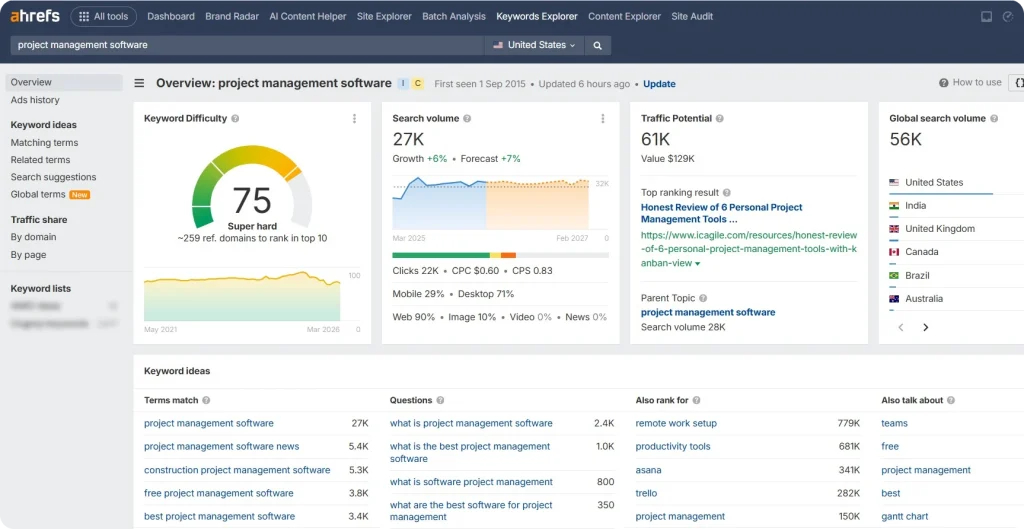
    • The Trust Gap: Despite adoption, 43% of businesses remain cautious due to potential inaccuracies or biases, highlighting the urgent need for AI Governance specialists professionals who often hold an msc in ai to develop the deep technical and ethical fluency required to govern AI systems responsibly.

    Why Systems Matter More Than Tools?

    The complete Artificial Intelligence Course requires students to learn about the System mind-set. 

    At the Boston Institute of Analytics, we emphasize that while tools like ChatGPT or Gemini are powerful, they are merely components. A system that needs to scale requires:

    • AI Engineering: Building the infrastructure (CI/CD pipelines) that allows models to be updated and deployed without human intervention.
    • Explainability: A governed system requires users to explain the AI decision-making process. At BIA, we teach this as a fundamental skill.
    • Scalability: Your AI needs to operate at maximum capacity from ten users up to ten million users when you implement cloud-native architectures (AWS, Azure, Google Cloud).

    The Boston Institute of Analytics Advantage

    Your education needs to evolve because the industry is progressing from its experimental phase to its complete transformation period. The Boston Institute of Analytics has the ability to create a solution that will address this educational requirement. The curriculum which we developed, stems from the expertise of more than 1500 industry professionals. These professionals currently build the systems which Apple, Google, and Meta use to maintain their market dominance.

    What BIA Offers: 

    • Industry-Aligned Training

    Our educational program goes beyond theoretical instruction. The Data Science Course requires students to complete more than 15 real-world case studies and a capstone project which develops their skills for handling high-pressure business situations.

    • Mastery in GenAI and Agentic AI

    Our training program includes specialized courses which teach participants how to develop and improve Large Language Models (LLMs) and create independent software systems.

    • 100% Placement Assistance

    Our training program provides you with skills while we assist your professional development through our network of more than 350 corporate partners which operates in multiple countries.

    • Global Recognition

    BIA offers a global certification program through its campuses located in Mumbai, Delhi, Sydney, and other international locations.

    Skills Required for the Modern Data Scientist

    To succeed in the AI era, data scientists must grow beyond outmoded roles. Key skills include:

    1. Programming and Tools
    • Python, R, SQL 
    • TensorFlow, PyTorch 
    • Cloud platforms (AWS, Azure, GCP) 
    1. Machine Learning and AI
    • Deep learning 
    • NLP and computer vision 
    • Generative AI 
    1. Data Engineering
    • Big data technologies (Spark, Hadoop) 
    • Data pipelines and ETL processes 
    1. MLOps and Deployment
    • Docker, Kubernetes 
    • CI/CD pipelines 
    1. Governance and Ethics
    • Explainable AI 
    • Bias detection 
    • Regulatory compliance 

    An all-inclusive Data Science Course equips students with these skills, while an Artificial Intelligence Course deepens know-how in advanced AI techniques.

    Final Thoughts: Leading the AI Era

    The development of data science from its experimental stage to its capacity for reaching widespread deployment at controlled systems shows how much AI technology has progressed. 

    Organizations are no longer satisfied with isolated models they demand end-to-end AI solutions that are scalable, reliable, and ethical. The current changes offer professionals who work in this field. The Data Science Course and the Artificial Intelligence Course provide you with essential skills for success in this evolving field. 

    People who understand both technical and strategic aspects of data science will become the leaders of upcoming industries which will emerge through AI development. Boston Institute of Analytics together with institutions like it, prepares students for their future careers in artificial intelligence.  

    FAQ: Data Science in the Age of AI

    What does “data science in the age of AI” actually mean?
    The field of data science has developed from its initial stage of basic data analysis and experiments into its current state which uses artificial intelligence for advanced systems. Data science work today focuses on creating intelligent systems which automate decision-making processes while continuously learning and maintaining operational performance across actual business settings.

    How is modern data science different from traditional data science?
    Data scientists from previous times used historical data to construct models which delivered insightful results. The current field of data science uses artificial intelligence to process data in real time while it maintains system performance during high-demand situations and it automates processes to work with existing business operations. The system requires ongoing assessment and model enhancement after its initial launch.

    Why is scalability important in data science projects?
    Data science solutions achieve scalability when they can manage extensive data sets and multiple users without encountering performance difficulties. In actual situations, models need to function effectively across various settings while they handle millions of users and adapt to evolving data patterns.

    What is meant by “governed systems” in data science?
    Governance systems for AI and data science models designate specific operational protocols which mandate organizations to maintain transparent operations while they track performance results and adhere to established ethical standards. The process involves protecting data privacy while also minimizing bias and fulfilling regulatory requirements through transparent model decision-making.

    What role does AI play in transforming data science?
    AI improves data science by providing automated systems and predictive analytics and advanced pattern recognition capabilities. The system processes unstructured data to produce insights at high speed while enabling decision-making without requiring constant human monitoring.

    What is MLOps and why is it important?
    Machine Learning Operations, commonly referred to as MLOps, provides a collection of methods which organizations use to build and operate machine learning systems throughout their production lifecycle. The framework ensures ongoing model performance through time by maintaining reliability and accuracy while ensuring models can handle increased demand which connects development work with operational activities.

  • End-to-End AI Marketing Funnel: From Product Idea to Video Ads to Sales

    End-to-End AI Marketing Funnel: From Product Idea to Video Ads to Sales

    If you’re a student with an early-stage product idea and wondering how to turn it into actual sales without spending heavily or hiring a team, you’re in the right place.

    Traditionally, building a marketing funnel involves multiple steps such as brainstorming, hiring designers, producing content, and running ads. All of this can be time-consuming and expensive, with no guaranteed results.

    However, with the rise of generative AI, this process has been transformed. Today, you can go from a simple idea to creating compelling video ads and generating sales within just a few days using entirely free tools.

    This end-to-end AI-driven marketing approach is especially powerful for students looking to promote side hustles, whether it is digital products or handmade creations.

    No fluff. Just clear steps that actually work.

    Why Does This Full AI Funnel Matters for Students?

    Traditional marketing funnels break because students lack time and money. AI fixes it by automating the boring parts: idea validation, content creation, ad targeting, and follow-ups.

    Businesses using AI across the whole journey see faster results and higher conversions. For you, it means testing ideas cheaply and scaling what works. Think of it as a complete system: idea → research → video ads → landing page → sales → optimization.

    Let’s walk through it stage by stage.

    5 Stages for Launching a Product Using AI

    Stage 1: Generate and Validate Your Product Idea with AI

    Most guides skip this. They assume you already have a finished product. Big mistake.

    Start with AI to brainstorm and check if anyone actually wants what you’re building.

    Step-by-step:

    • Use ChatGPT or Google Gemini (both free). Prompt: “Brainstorm 10 product ideas for [your niche, like study tools for college students]. Make them unique, solve real pains, and include why they’d sell.”
    • Pick one idea. Then validate it fast. Ask Gemini: “Act as a market researcher. Analyze demand for [product idea] among college students. Pull insights from trends, Reddit-style pain points, and competitor gaps.”
    • Go deeper with free tools like Perplexity.ai for real-time search summaries or Gemini’s Deep Research mode to scan forums and reviews without paying for surveys.

    Real example: A student I know had an idea for AI-generated study summaries. AI showed high demand on Reddit (students hate long textbooks) and low competition in her niche. She moved forward. Without this step, you’d waste weeks on something nobody wants.

    This stage takes 30-60 minutes and saves you from bad ideas.

    Stage 2: Build Buyer Personas and Do Smart Market Research

    Now turn your validated idea into something people will buy.

    AI creates detailed buyer profiles and uncovers hidden insights competitors miss.

    How to do it:

    • Prompt ChatGPT: “Create 3 detailed buyer personas for [product]. Include age, pains, goals, where they hang out online, and what would make them buy.”
    • Use Gemini for research: “Summarize top 5 customer complaints about [similar products] from recent reviews and forums.”
    • Spot gaps: Ask “What features are missing in top competitors like [name them]?”

    Output: Clear personas like “Busy engineering major who needs quick, mobile-friendly notes.” This guides every later step—scripts, ad copy, even pricing.

    Students win here because AI does the research homework for you.

    Stage 3: Create High-Converting Video Ads with AI (From Script to Finished Video)

    Video ads drive the most attention right now, especially short ones for TikTok, Instagram, or Meta. Traditional production costs thousands. Generative AI does it for free or under $20.

    Practical workflow (takes 1-2 hours):

    Script generation: Enter your personas and product information into the chatbot. Prompt for the chatbot: “Write a script for a 15-30 second video ad for [product] targeting [persona]. Begin with pain points, show the solution, end with a call to action. Make it friendly and engaging.”

    Visuals and video:

    • Canva Magic Studio (free version) or Kapwing can transform the script into a complete video – auto-adds images, animations, voiceover, and subtitles.
    • Better videos can be created using Leonardo.Ai (free tokens every day) or Runway (free version) – generates customized scenes from text descriptions like “college student smiling while using app on phone.”
    • Voiceovers: ElevenLabs (free version) or CapCut AI voiceover tool.

    Polish: Edit in CapCut (completely free) to match your style, add text overlays, and test hooks.

    Add interactive video elements (this boosts engagement big time—think polls, questions, or clickable stickers that turn passive viewers into active participants). In 2026, platforms reward this: interactive features can double watch time and lift completion rates way above normal videos.

    Here’s how to do it easily in your workflow:

    • In CapCut (your main polish tool): Once your video is built, go to the stickers/effects section. Add a poll sticker, question stickers, or even an emoji slider directly on your frames. For example, at the end of your ad, add a poll asking “Need better study notes? Yes/No” or a question asking “What’s your biggest exam struggle?”
    • For TikTok native upload: Once your ad is exported from CapCut, go to TikTok. Tap “create,” then “upload.” Tap “edit,” then go to “stickers.” Select “Poll” or “Question.” Place it on your ad, especially on key frames (e.g., right after showing your pain point). Your viewers will then tap to vote or reply, perfect for comments, shares, and algorithm love.
    • For Instagram Reels: When creating your Instagram Reels, add a poll, quiz, question, or even an emoji slider. Export your AI video, then go to Instagram. Tap “create,” then “upload.” Tap “edit,” then go to “stickers.” Select “Poll,” “Quiz,” “Question,” or “Emoji Slider.” Place it strategically on your Reels, e.g., “Swipe up if this helped!” or even a quick quiz on your benefit.
    • Pro tip for students: One interactive element per 15-30 second ad, max! Don’t overload your ad with too much. Test what works: polls on pain points get replies; questions on solutions spark DMs and leads.

    Example: 

    • A student created a 20-second ad for custom planners
    • The ad followed a simple flow: tired student → organized life → buy now
    • They added an interactive poll sticker using CapCut or TikTok
    • Poll question: “Struggling with deadlines? Yes or No”
    • The video gained thousands of views on TikTok without any filming
    • It also generated a large number of poll responses
    • These responses were used for follow-up direct messages
    • Resulted in meaningful engagement and actual sales

    These videos (now with interactive boosts) feed straight into your ads and funnel. Higher engagement = cheaper clicks and warmer leads. Start adding one interactive element to your next test—watch the difference.

    Stage 4: Build Your Sales Pages, Emails, and Automation

    Video ads send people somewhere. Make that landing page convert especially if you’re doing eCommerce marketing with digital downloads or print-on-demand merch.

    Easy steps:

    • Try free AI builders like Framer AI or Carrd, and give the AI the following prompts: “Design a simple landing page for my [product] with a headline, benefits, testimonials, and buy now.” (Follow a basic SEO guide: Make sure your website is easily readable with clear headings, fast-loading design, a mobile-friendly layout, and incorporate the keywords into the titles/descriptions so Google and AI searches can find you!)
    • Write engaging content with ChatGPT: “Write persuasive copy for my new buyers, including the product description, FAQ, email sequence, etc.”
    • Use automation with free tools like Mailchimp, an AI email writer, or ManyChat, an Instagram DM auto-responder. Give the AI the following prompts: “Write a follow-up email to a person who watched my video ad but didn’t buy my [product]…”

    Add a simple checkout with Stripe (free to start). The whole page and emails can be live in under an hour.

    Stage 5: Launch Ads, Nurture Leads, Close Sales, and Optimize

    Run targeted ads, let AI tools handle the rest, and watch sales come in.

    Launch and run:

    • On Meta or TikTok Ads (low budget start at $5/day), upload your AI video. Use platform AI suggestions for targeting based on your personas.
    • Track using free Google Analytics or insights provided by Meta. Ask ChatGPT: “Analyze these ad results and suggest improvements.”

    Nurture and sell:

    • Free AI chatbots on ManyChat/Tidio can be used to answer questions 24/7.
    • Predictive Lead Scoring: Utilize free versions of HubSpot or even ChatGPT analyzing email opens.

    Optimize the loop:

    • Feed results back into AI: “Based on these sales data, improve my next video script.”
    • AI spots patterns—like which video hook works best—and auto-suggests A/B tests.

    Real student win: One launched study-note templates. AI video ads cost $10, generated 200 clicks, and closed 35 sales in week one. Then AI optimized the emails to double repeat buyers.

    What Most Guides Overlook and What Makes This Different?

    Most well-known marketing guides, including those from industry voices like Neil Patel, focus on refining existing funnels rather than building one from the ground up. They highlight strategies like personalization and data analysis, but often skip the crucial first step: turning a simple idea into a working system that generates attention and sales.

    They also tend to overlook practical execution. There is little emphasis on using free tools or creating video content efficiently from start to finish.

    This guide takes a different approach. It focuses on helping you move from idea to execution with clarity and speed. You will learn how to validate your concept, create engaging AI-powered videos using tools like Canva and Kapwing, and set up simple automation to convert interest into sales.

    The entire process is designed to be accessible, requiring no large budget, no advanced skills, and no team.

    Actionable Tips to Get Started Today:-

    • Begin small: Pick one idea, build one video ad, run $10 in ads.
    • Stay human: Always review AI output for your voice—AI drafts, you approve.
    • Track simply: Use a free Google Sheet. Log cost, clicks, sales weekly.
    • Test ethically: Be honest in ads. AI speeds things up, but trust builds sales.
    • Scale what works: Once one funnel hits, duplicate for new products.

    Conclusion

    The end-to-end AI marketing funnel turns students from dreamers into sellers. You now have every stage from raw product ideas through killer video ads to actual money in your account covered with free or cheap tools.

    Starting tonight. Pick your idea, open ChatGPT, and build the first piece. In a week, you’ll have something to live and learn. The tools are ready. The only question is: what’s your first product?

    FAQs

    Can I really do this with zero budget?

    Yes. ChatGPT, Gemini, Canva, and CapCut cover 90% for free. Spend only on small ad tests once you’re ready.

    How long does the whole funnel take?

    First version: 1-2 days. Then it runs mostly on autopilot.

    What if my video ads don’t convert?

    AI analyzes results and suggests fixes in minutes. Tweak the hook or targeting and relaunch.

    Is this only for digital products?

    No. Works for physical items too (use AI for mockups and print-on-demand links).

    Will AI replace me as the creator?

    No. It handles the grind. You bring the ideas and final judgment—customers buy from real people.

    Ready to build yours? Grab your laptop and go. You’ve got this.

  • Video Marketing Services: A Complete Guide for Businesses

    Video Marketing Services: A Complete Guide for Businesses

    Are you still thinking of video marketing as something impossible to do, because you don’t have video marketing knowledge and skills? 

    Then you are actually losing one of the most powerful marketing tools.

    And the good news is that even if you don’t have video content creation skills, a creative mind, or the necessary equipment, there are various agencies out there that you can partner with and reach your marketing goals.

    Let’s see why video marketing is an important marketing tool, what stages it includes, and how to find the best video marketing services.

    Why is Video Marketing Powerful?

    Video marketing is the process of creating video content about a brand for promotional purposes. Today, it is a powerful component of any brand’s content marketing strategy. It is used to spread brand messaging through engaging video format and storytelling.

    Let’s be honest, video content is usually easier to digest than text-based content. That’s why more people are now turning to videos, and more brands are choosing to use video marketing services in their overall marketing campaign. 

    Supporting this idea with numbers, according to Twinstrata, 80% of consumers choose video over reading. Meanwhile, viewers retain 95% of a message when watching a video, while only 10% when reading a text.

    Here’s an example of Shopify. On its website, you can find a storytelling video named “Why we build Shopify”. It explains the story behind the brand, provides a product overview, and its purpose.Screenshot of Shopify website video content

    So, if you want to deliver your brand messaging more effectively, going for video marketing services is definitely a win-win.

    What Are the Main Types of Video Content?

    There is a large variety of video content used in different stages of a sales cycle, for example:

    • If you want to grab your leads’ attention in the awareness stage of your sales cycles, you might consider using short-form, engaging social media videos or educational brand clips.
    • Now that you have potential customers, explainer videos, product overviews, tutorials, and webinars will work best.
    • And in the final stage, where your customers are about to make a purchase, you can deliver case studies, customer testimonials, and more long-format, detailed content.

    Keeping these distinctions in mind will make content planning easier and help you choose the right video formats for each stage of the sales cycle.

    What Are the Main Stages of Video Marketing Services?

    No matter whether your video marketing services are handled in-house or outsourced, having a clear understanding of the main stages of a video marketing campaign will help you keep your efforts aligned with your overall strategy.

    Here they are: 

    Video Strategy Planning

    This is the very first step of your video marketing efforts. Here, you need to have a clear understanding of your target audience, brand messaging, and video formats for each stage of your campaigns.

    Have a look at your competitors and how they are carrying out their video marketing campaign.

    To make your vision clear, ask yourself these core questions:

    • Who do you want to produce these videos for? 
    • What message do you want to deliver?
    • What goals do you want to achieve with your video content?

    If you are the one handling the process, you also purchase the necessary equipment to make your video production technically possible.

    Remember that the number of people and the type of equipment involved will depend on the scope and complexity of the video campaign.

    Pre-Production Preparations

    After having your ideas clear, you start scheduling the production of your interactive content, forming the content calendar, and drafting the scripts for each video. 

    Here, make sure you also finalize all the visual and sound effects, storyboards, and any other necessary details that will make your video production efforts successful.

    Video Production

    And here it comes, the filming stage.

    • If you or your team members are being filmed, remember to smile and stay natural. Trust the process; your authenticity will resonate with the audience.
    • If you are outsourcing video production, make sure you or a representative from your team is present during filming to ensure everything goes smoothly and you are in tact with your marketing vision.

    Check the lighting, sound, visuals, and equipment to ensure high-quality video content. It is also a good idea to review the script once again before recording begins.

    Video Posting and Promotion

    After collecting all the video materials, you then turn to editing and posting them on the relevant channels.

    However, simply posting videos is not enough. 

    Your content will reach its full potential only when you actively distribute it across social media, your website, and any other channels where your target audience spends time. 

    Additionally, repurpose each video to suit the format and style of every platform for maximum engagement.

    Video SEO and Optimization

    SEO optimization is crucial for your video marketing services. If you want your videos to rank on video platforms, you need to optimize your video content accordingly. 

    Include keywords and questions your users are actually searching for on search engines. 

    If you wonder how you can do this, professional SEO tools like Ahrefs can help you with these insights.

    • After you log in to Ahrefs, go to the “Keyword Explorer” section.
    • Enter a seed keyword that your potential customers are searching for. Let’s bring an example here. Imagine you are offering project management software and you want to launch a video marketing campaign promoting your software. The broadest keyword your audience is most probably searching for online is “project management software.” So, in the “Keyword Explorer” section, type in this keyword. Here’s what you will get:Overview of Ahrefs Keyword Explorer section
    • Now explore the “Terms match” and “Questions” sections to see all the trending keywords. For an easier ranking, start with keywords with lower keyword difficulty by putting the necessary filters (let’s say 0-40 KD). Screenshot of matching terms results for project management software keyword

    After choosing those that also fit your content strategy, you can place them smoothly in your titles, descriptions, subtitles, and video tags.

    Performance Tracking and Analytics

    After your videos are surfacing online, regularly check necessary metrics such as views, likes, comments, and engagement. 

    This will help you measure your video campaign performance and identify which content needs further improvement.

    Video Marketing Services: The Selection Checklist

    So, if you are choosing to rely on outsourced partners, you are probably wondering how to choose the best video marketing services from hundreds of agencies.

    Here is a checklist you can use along your selection process:

    • Be clear about what you want: Picture what your videos should look like, the messaging, the style, everything. This will help you filter those that match your vision.
    • Discuss budget: Pricing plans differ for every agency, depending on the scale of services they provide. Make sure you ask for a price for the scope of services you want to get and whether or not their prices match your marketing budget.
    • Ask for samples: You can also ask for a portfolio of previous video campaigns to get clearer insights into what kind of videos each agency creates.
    • Review testimonials: Reviewing customer testimonials will help you understand the agency’s strengths, reliability, and the results they’ve delivered for other businesses.  
    • Clarify timeframes: During the negotiation and contracting process, be clear about the deliverables, timelines, and communication procedures.

    Depending on the scale of your video marketing campaign, additional steps may be required to land on the agency that will fit your video marketing goals. 

    Having a clear roadmap ensures you progress smoothly and achieve your goals with minimal hassle.

    Conclusion

    Nowadays, video marketing services are widely accessible, with thousands of agencies providing them. 

    While this variety can feel overwhelming, taking the time to research and communicate with potential partners can make the selection process much easier.

    It is also important to have a clear vision for your video marketing campaign so your expectations align with the final results.

    With the right strategy and the right agency, video content can become a powerful driver of brand awareness, engagement, and business growth.