Sales teams today are working harder than ever, yet many struggle to see consistent gains in productivity. Calls are being made, emails are sent, reminders are set, and follow-ups are attempted. On the surface, everything looks busy. But beneath this activity lies a silent issue that slowly erodes performance: manual follow-ups.
Manual follow-ups rarely fail loudly. They do not trigger alerts or sudden breakdowns. Instead, they fail quietly through missed callbacks, delayed responses, forgotten leads, and inconsistent communication. Over time, these small gaps add up, costing sales teams valuable time, momentum, and revenue.
In this article, we explore why manual follow-ups are one of the most overlooked productivity killers in sales and how modern teams can move beyond them.
What Are Manual Follow-Ups in Sales?
Manual follow-ups refer to any sales follow-up process that depends heavily on human memory, personal reminders, or disconnected tools. This often includes tracking leads in spreadsheets, setting individual calendar reminders, sending follow-up emails manually, or relying on WhatsApp messages without a centralized system.
At first, this approach feels manageable. A salesperson may remember whom to call back, jot notes in a notebook, or update an Excel file at the end of the day. For very small teams or low lead volumes, manual follow-ups can appear to work.
However, as lead volume increases and sales cycles become more complex, manual follow-ups stop being reliable. The process becomes reactive rather than structured. Follow-ups happen when someone remembers, not when they should happen.
This is where many teams begin exploring what a CRM is and why it exists in the first place. CRM systems were designed to remove dependence on memory and manual tracking, especially for time-sensitive sales activities like follow-ups.
Key Challenges of Manual Follow-Ups
Manual follow-ups often seem workable at first, especially when sales teams are lean and deal volume is manageable. But as pipelines grow and daily priorities compete for attention, the limitations of a manual approach become clear. What starts as a small operational gap slowly turns into a recurring productivity issue that affects both sales outcomes and customer experience.
- Missed Opportunities Due to Human Error
Even the most disciplined sales professionals are human. Calls get interrupted, meetings run long, and urgent tasks take priority. When follow-ups rely on memory, personal notes, or scattered reminders, leads inevitably slip through the cracks. Many of these missed follow-ups are caused by poor data alignment across tools, which makes it harder for sales teams to respond at the right time
A missed follow-up often means more than just a delayed call. It can result in a prospect choosing a competitor, losing interest, or questioning a company’s responsiveness. These losses rarely appear clearly in performance reports, which is why the damage caused by missed follow-ups often goes unnoticed until conversion rates start declining.
- Sales Reps Spend More Time Managing Tasks Than Selling
Manual follow-ups force sales reps to spend a significant portion of their day managing tasks rather than engaging with prospects. Updating spreadsheets, checking old emails, reviewing notes, and figuring out who needs a follow-up all consume mental energy that could be better spent on conversations.
This constant task switching reduces focus and lowers overall efficiency. Instead of moving confidently from one sales interaction to the next, reps spend time organizing their workload and trying to stay on top of reminders. Over weeks and months, this administrative burden compounds and directly impacts overall sales productivity.
- Inconsistent Customer Experience
When follow-ups are handled manually, consistency becomes difficult to maintain. One prospect may receive timely, thoughtful follow-ups, while another hears back days later. Messaging varies from rep to rep, and there is no standard cadence guiding outreach.
From a buyer’s perspective, this inconsistency creates friction. Modern buyers expect prompt, relevant communication at every stage of the sales process. When follow-ups feel disorganized or delayed, trust erodes quickly, even if the product or service itself is strong.
Individually, these issues may seem minor or unavoidable. Together, they create a pattern of lost momentum, reduced focus, and uneven engagement that directly affects sales performance. Without a structured approach to follow-ups, teams spend more time reacting than selling, allowing productivity to decline quietly over time.
How Manual Follow-Ups Impact Sales Productivity
Manual follow-ups may seem manageable at first, but as sales activity increases, their impact on productivity becomes more visible. What starts as a simple way to track tasks slowly turns into delays, missed opportunities, and reduced focus. Over time, these small inefficiencies add up, affecting how sales teams respond to leads, manage conversations, and maintain momentum across the pipeline.
• Slower Response Times to Leads
Sales reps handling follow-ups manually often respond later than they should, not because of poor effort, but because reminders are scattered across inboxes, calendars, spreadsheets, and personal notes. Valuable time is lost identifying who needs attention next, and even short delays can reduce engagement with high-intent prospects.
• Less Time Spent on Actual Selling
Manual follow-ups force reps to spend a significant portion of their day managing tasks rather than having sales conversations. Constantly checking spreadsheets, reviewing emails, or searching notes interrupts focus, reduces momentum, and limits the number of quality interactions a rep can handle in a day.
• Broken Momentum in Long Sales Cycles
Deals that require multiple touchpoints depend on consistent and timely follow-ups. When follow-ups are handled manually, communication gaps appear. Prospects disengage not because of lost interest, but because the sales team failed to re-engage at the right moment, leading to stalled deals and inflated pipelines. Without a structured content marketing strategy supporting follow-ups, sales teams struggle to maintain engagement across longer buying cycles.
• Increased Mental Load and Burnout
Remembering follow-ups, managing reminders, and avoiding mistakes adds cognitive stress over time. High-performing sales reps often compensate by working longer hours, which accelerates burnout without improving results. What appears to be a performance issue is often a system limitation.
• Limited Visibility for Sales Managers
Without centralized tracking, managers struggle to see follow-up quality and timing. Activity reports may show calls and emails, but they rarely reveal delayed responses or missed follow-ups. This leads to reactive coaching, less accurate forecasting, and productivity issues hidden behind surface-level metrics.
Manual follow-ups may not stop sales teams from working, but they quietly reduce efficiency at every stage of the sales process, gradually eroding overall sales productivity.
Why Scaling Sales with Manual Follow-Ups Is Nearly Impossible
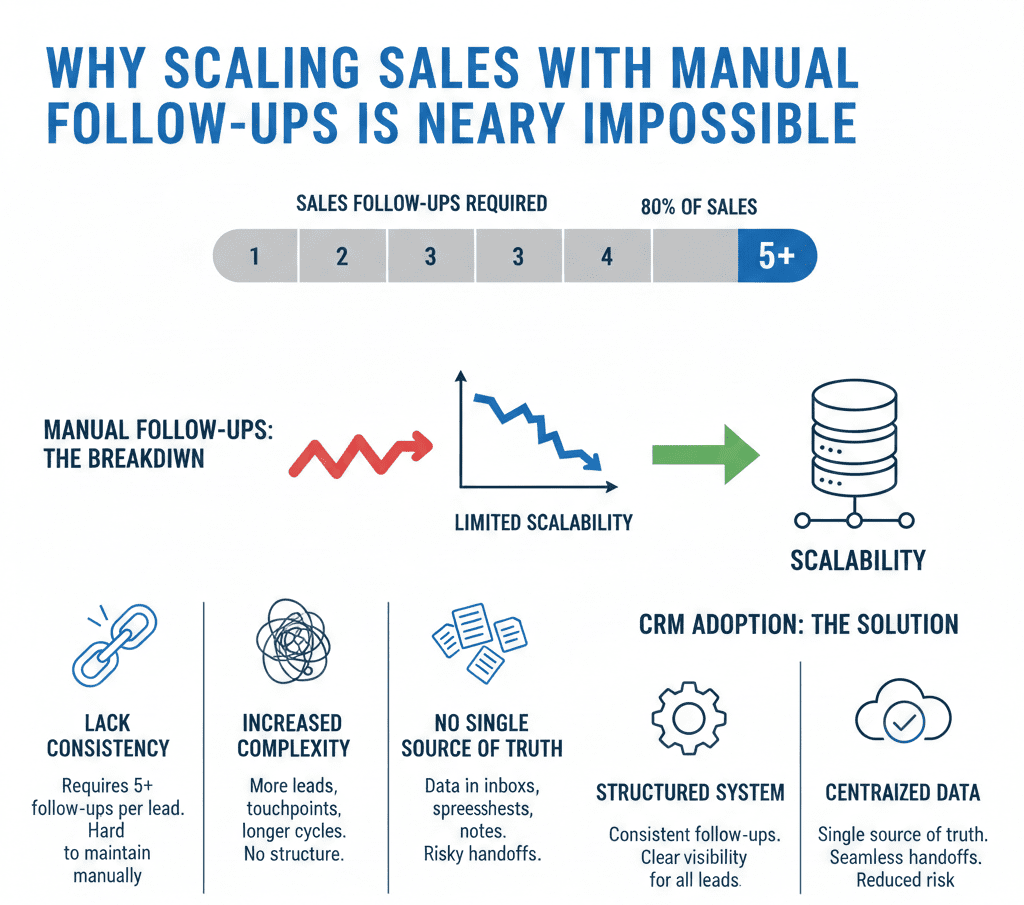
Manual follow-ups might survive at a small scale, but they break down completely as teams grow. In fact, research by RAIN Group shows that 80% of sales require five or more follow-ups, making consistency nearly impossible to maintain manually.
As more leads enter the funnel, the complexity of follow-ups increases. Multiple touchpoints, longer buying cycles, and multiple stakeholders demand structure and visibility, something manual systems cannot provide reliably.
There is no single source of truth. Data lives across inboxes, spreadsheets, and personal notes, increasing risk during handoffs between sales reps, especially when someone is on leave or exits the organization.
This is why one of the key benefits of CRM adoption is scalability. A structured system ensures that follow-ups remain consistent and visible, regardless of team size or lead volume.
How CRM Automation Fixes the Follow-Up Problem
CRM automation does not replace salespeople. It removes the friction that slows them down.
A well-implemented CRM ensures that follow-ups happen at the right time, without relying on memory. Automated reminders, task creation, and follow-up workflows keep sales reps focused on conversations rather than administration.
Key improvements include:
- Automatic follow-up reminders based on lead activity
- Centralized communication history for every prospect
- Visibility into what has been done and what is pending
Reduced manual data entry
For teams evaluating how to move away from manual processes, understanding how to choose the best CRM solutions becomes critical. Not all CRMs are designed with automation and usability in mind.
Why Cloud-Based CRMs Are Better for Modern Sales Teams
Modern sales teams are no longer confined to desks. Remote work, field sales, and distributed teams are now common. Cloud-based CRM platforms support this reality far better than traditional systems.
With a cloud-based CRM, sales data is accessible in real time from anywhere. Updates made by one team member are instantly visible to others. Follow-ups remain on track even when teams are working across locations or time zones.
Additionally, cloud-based systems reduce dependency on manual backups, local installations, and outdated software versions. They encourage faster adoption and better collaboration across teams.
For businesses exploring this shift, understanding cloud CRM benefits and features to look for can help ensure the CRM truly supports productivity rather than adding complexity.
Manual Follow-Ups vs Automated Follow-Ups

The difference between manual and automated follow-ups becomes clear when they are compared side by side. While both aim to keep prospects engaged, the way they operate has a direct impact on efficiency, consistency, and overall sales performance.
| Aspect | Manual Follow-Ups | Automated Follow-Ups |
| Follow-up tracking | Relies on memory, notes, or spreadsheets | System-driven with automatic task creation |
| Timeliness | Often delayed due to missed reminders | Timely follow-ups based on predefined workflows |
| Consistency | Varies by sales rep and workload | Standardized and consistent across the team |
| Error rate | High risk of missed or forgotten follow-ups | Minimal human error |
| Time spent by reps | Significant time spent managing tasks | More time focused on selling and conversations |
| Scalability | Becomes difficult as the lead volume grows | Scales easily with growing pipelines |
| Visibility for managers | Limited or fragmented visibility | Clear view of follow-ups and pipeline status |
| Impact on productivity | Gradually reduces efficiency | Improves response time and overall productivity |
As sales volumes grow, the limitations of manual follow-ups become harder to ignore. Automated follow-ups provide the structure and reliability needed to maintain momentum, reduce errors, and support long-term sales productivity and pairing this with a streamlined automated approval process further eliminates bottlenecks in sales workflows to keep deals moving forward efficiently.
How to Choose the Right CRM to Eliminate Manual Follow-Ups
Choosing the right CRM is not about selecting the most feature-rich tool. It is about finding a system that genuinely supports daily sales workflows.
Key factors to consider include:
- Ease of use and quick onboarding
- Strong follow-up automation capabilities
- Clear activity tracking and reporting
- Integration with existing tools like email and calling
Flexibility to adapt as the team grows
Businesses comparing platforms often benefit from reviewing guides on the best CRM software and how to choose the right CRM, especially to avoid overcomplicated systems that create new productivity challenges.
Productivity Is Built on Systems, Not Effort
Manual follow-ups do not fail overnight. They fail quietly, one missed reminder and one delayed response at a time. Sales teams often compensate by working longer hours, assuming the issue is effort rather than structure.
True sales productivity comes from systems that remove friction, and a well-implemented CRM plays a central role in making that possible. When follow-ups are automated, visible, and consistent within a CRM, sales reps no longer need to rely on memory or manual tracking. Instead, they can focus on what they do best: building relationships, having meaningful conversations, and closing deals.
For organizations serious about improving sales productivity, eliminating manual follow-ups through a structured CRM is not a minor optimization. It is a foundational shift toward a more disciplined, scalable sales process that delivers long-term performance gains.