You’ve built the perfect website for your business, but is it truly ready to stand out and attract visitors?
In most cases, a visually impressive website with an outstanding and fancy interface is not enough to ensure its online success.
There are essential steps and strategies you need to follow to ensure your website performs well online.
In this article, we’ll cover some of the most effective website marketing strategies that help people discover your site and actually visit it.
What is Website Marketing and Why is it Important?
Website marketing involves using the right techniques and strategies to promote your website.
Simply creating and launching a website is not enough. If people are unaware of your site, they will not visit it. As simple as that. That’s why, with the growing influence and importance of digital channels, website marketing cannot be overlooked.
It offers several key advantages for your website:
- Increased visibility and online presence: If you properly promote your website, it will appear on the right channels, at the right moments, and your people will need to see it.
- Global audience reach: Digital channels open the doors to the world, so with proper marketing efforts, your services will be visible to people all around the world
- Improved lead generation and conversion: As more people visit your website, more people will get interested in your services, try them, and become customers.
Of course, these are not the results that will appear instantly. It can take you months and even years to achieve the desired outcome. However, there is no other choice than investing your time and resources in website marketing.
Website Marketing: 5 Strategies for Your Online Success
So, if you are convinced and ready to go, here are all the most common and key strategies of website marketing.
-
Ensure Smooth User Experience
You might get surprised, but your website marketing strategy starts from your website.
Not reinventing the wheel, but if your website’s user experience is bad, the bounce rate will rise. Instead, a visually appealing, fast, and responsive website will make your visitors stay longer and engage more with it.
So, to ensure a seamless website user experience, here are some points you need to keep in mind:
- Website speed: Make sure your website doesn’t take too long to load. People usually click the X and close the window if they don’t get the site loaded within a couple of seconds.
- Mobile-friendly: As people go everywhere holding their smartphones, your website should be ready for this too. It shouldn’t be cranky when opened on a mobile phone; all the content should be easy to access and read via mobile.
- Clear structure: Make sure your website has clear headers and menus that are easy to navigate. Wrong page redirects can become another source of confusion and frustration for your visitors.
- Pro tip: Use 301 redirects to guide visitors from outdated or duplicate pages to the correct ones, keeping navigation smooth and preserving your SEO value.
- No broken pages: Along with correct redirection, your website pages should also be accessible. Keep an eye on your broken pages to fix them as soon as possible.
By focusing on these elements, you can create a website that not only attracts visitors but keeps them engaged and satisfied, ultimately supporting your overall marketing goals.
-
Utilize Search Engine Optimization
Search Engine Optimization (SEO) is the process of optimizing your website for search engines, so that it appears on top of SERPs. When people search for problem solutions, and you are the one offering them, SEO strategies will help you let people know about this. To do so, you use different on-page and off-page SEO techniques such as keyword optimization, content creation, link building, and many more.
For example, if you are offering translation services, you need to make sure that your website pops up on search engines when people search for “translation services” or other related terms. By using professional SEO tools like Ahrefs, you can identify such keywords and optimize your website content by including them smoothly in it.
Here’s what it looks like on Ahrefs:
- After you log in to your Ahrefs account, go to Keyword Explorer.
- Type in “translation services”, which is your broad keyword. And see what other Matching Terms or Questions are ranking. Look for their metrics to choose those that will help you rank more easily. It is usually suggested to start with keywords that have lower keyword difficulty but higher search volume.

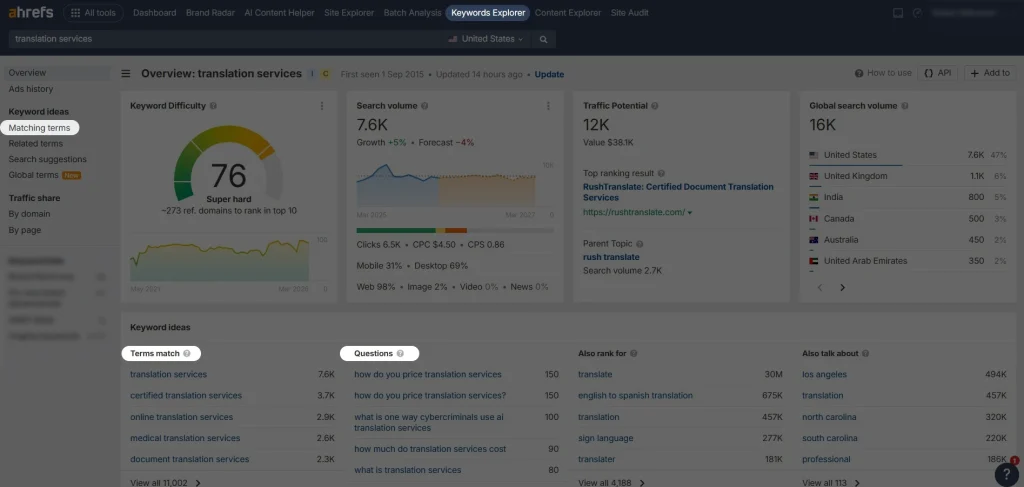
You can also get insights on what people search for on Google, simply by doing the same as they do. Type in “translation services” in Google search, and all other related keywords will be listed too. For long-tail keywords, check out the “People also search for” section.
When doing your website SEO, don’t forget about AI SEO, as more people are now turning to AI-driven search engines to find answers to their questions.
Here’s how you can make your website AI-friendly:
- Create authentic content that provides reliable information. Use long-tail keywords, target informational search intent, and incorporate listicles to make content more digestible.
- Build trustworthy backlinks from high-quality websites, especially those relevant to your industry, to boost authority and credibility.
- Make your website easy to scan by organizing content with clear sections, headings, bullet points, and concise paragraphs.
If your products or services target a specific location, this is where you should also explore local SEO principles, such as:
- Optimizing your Google Business Profile
- Creating content for a local audience
- Encouraging customer reviews and testimonials
- Building backlinks from local sources
- Monitoring your local competitors
To sum up, your SEO efforts will help you to target the right audience and drive consistent, organic traffic.
-
Explore Social Media Marketing
Social media plays a key role in business promotion. People spend a lot of time scrolling reels, reading posts, or sharing content themselves. And this is where your website marketing efforts should shine bright enough.
For effective social media marketing:
- Choose the right social media platform where your audience is more active.
- Depending on the platform, share the relevant content type (a text-based post, long or short-form video). For example, if it’s LinkedIn, informative text-based posts work best. For Instagram or TikTok, go for reels, and for YouTube, consider long-form videos and podcasts.
- To drive traffic from your social media posts, make sure you include clear Call-to-Actions (CTAs), which will further encourage your audience to visit your website.
- Leverage influencer marketing, too. Here, people with a ready-built audience base will help you spread the word about your business and encourage them to check out your website.
Social media marketing is a powerful support for your overall website content marketing efforts. Once you create valuable content on your website (such as blog posts, guides, or infographics), social media platforms come to help distribute and promote it, driving additional traffic to your website.
-
Use Pay-Per-Click Advertising
Pay-Per-Click Advertising (PPC) is a type of advertising strategy where you pay for the clicks of people who are then redirected to your website. This drives traffic to your website and can also lead to a purchase.
PPC provides flexible advertising conditions for your business as you choose and control your advertising budget, target audience, and advertising platforms. Speaking of advertising platforms, where your ads can appear, these are the most common ones:
- SERP ads: Your ad appears on top of search results, at the right place, in front of the right people who search for your business
- Social media ads: Your ad appears on social media platforms like Instagram, Facebook, and YouTube
- Display ads: Your ad appears on other websites that your target audience visits.
One of the most common tools to run your ad and monitor its performance is Google Ads, which allows you to set up your account, determine your ad budget, and search for terms you want to target. 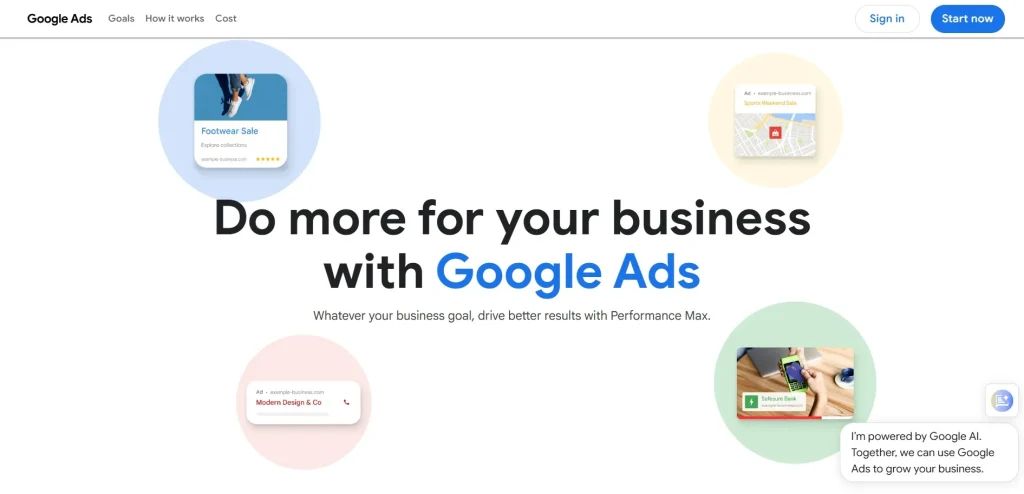
However, if you want to go deeper into your PPC strategy, you can turn to PPC agencies that will handle it for you.
-
Analyze Performance
After completing these steps and actively practicing website marketing, it is important to track your performance and see how your website is doing online.
The frequency of your analytics tracking depends on your goals, metrics, and the changes made to your website. Key metrics like organic traffic and user behavior can be monitored weekly, while overall performance and trends are typically reviewed monthly. However, if you are running campaigns or making updates, more frequent monitoring may be necessary to measure their impact.
There are several key metrics you should monitor:
- Website traffic: Visitor numbers and traffic sources, such as organic search, social media, or direct visits
- Engagement: Bounce rate and average engagement time,
- Social media metrics: Such as likes, shares, and comments,
- Conversion metrics: Conversion rates, sign-ups, and purchases
To track these metrics, you can use useful tools such as:
- Google Analytics, which helps you monitor website traffic and user behavior
- Ahrefs or other SEO tools to track keyword rankings, backlinks, and overall SEO performance
For example, Ahrefs provides a detailed overview of your website performance in the “Site Explorer” section. By entering your domain and setting the desired time period, you can access insights like domain rating, backlink profile, organic traffic, and keyword rankings.
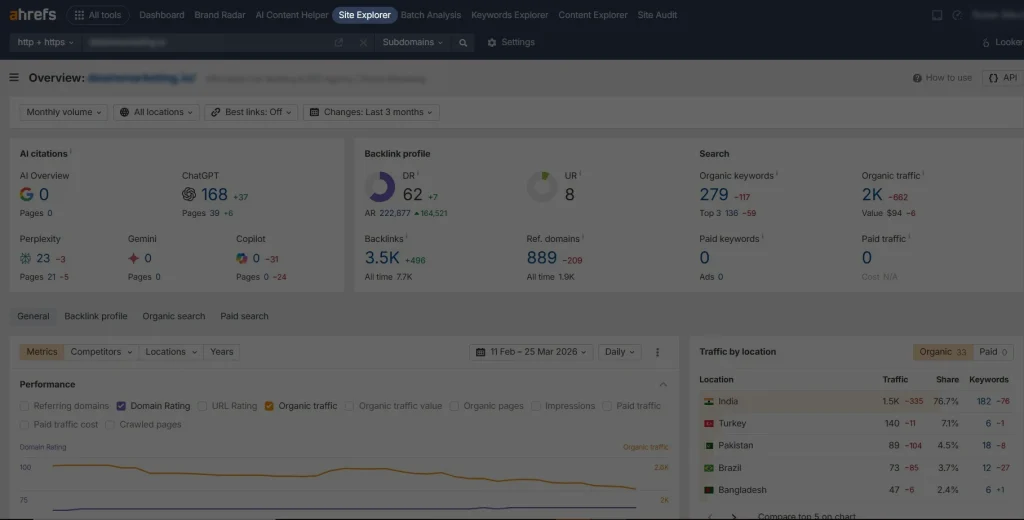
If you scroll down, you can see an interactive graph showing how metrics change over the specific time period that you filter. Just tick the relevant boxes of Referring domains, DR, organic traffic, and others.
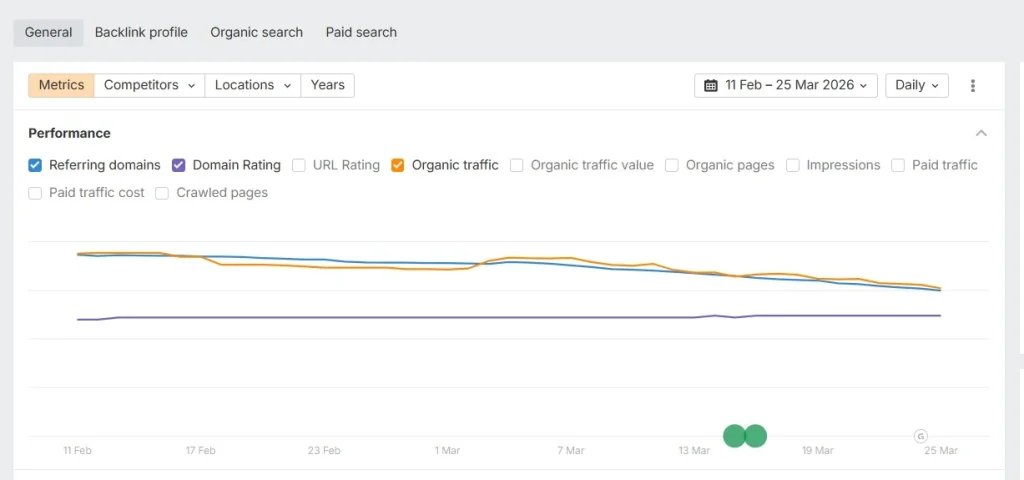
Without this kind of data analysis, it becomes hard to spot gaps and improve your strategy effectively. It is also important to keep an eye on your competitors’ performance to see where you stand and find chances to outperform them.
Conclusion
To build a strong and lasting online presence, website marketing is what you need to do, as your website is an important platform to attract new visitors and convert them into customers.
Without effective website marketing, your site may go unnoticed and get lost among countless others online.
There are several core components to focus on along the way, from delivering a smooth user experience to consistently tracking and improving your performance.
So, make sure you put enough time and effort not only in your website development and design, but in its marketing.