SEO Keyword Mapping: A Step-By-Step Guide
Are you getting ready to launch your website but noticing that everything feels a bit confusing?
One common reason is the lack of SEO keyword mapping.
This step is essential because it helps you structure your categories, makes crawling easier for search engines, and brings more clarity to your overall content.
Below, we will explore why it matters and walk through the steps you need to follow, so stay tuned.
What is SEO Keyword Mapping?
In short, it is the process of linking specific keywords to the most relevant pages on a website.
And in practice, it involves researching keywords and grouping them by topic and intent. Then, you map those groups to existing pages or pages that need to be created.
This provides a clear outline of what each page should focus on and how your site can grow.
Why Do You Need an SEO Keyword Mapping?
SEO keyword mapping includes several important benefits for your website. By properly mapping your industry keywords:
- Each page of your website targets a clear search intent to help search engines understand what each page covers.
- It prevents pages from competing for the same terms, eliminating the possibility of a duplicate content penalty
- Makes planning website content strategy easier.
Here’s an example of a mapping structure for an online store selling boots.
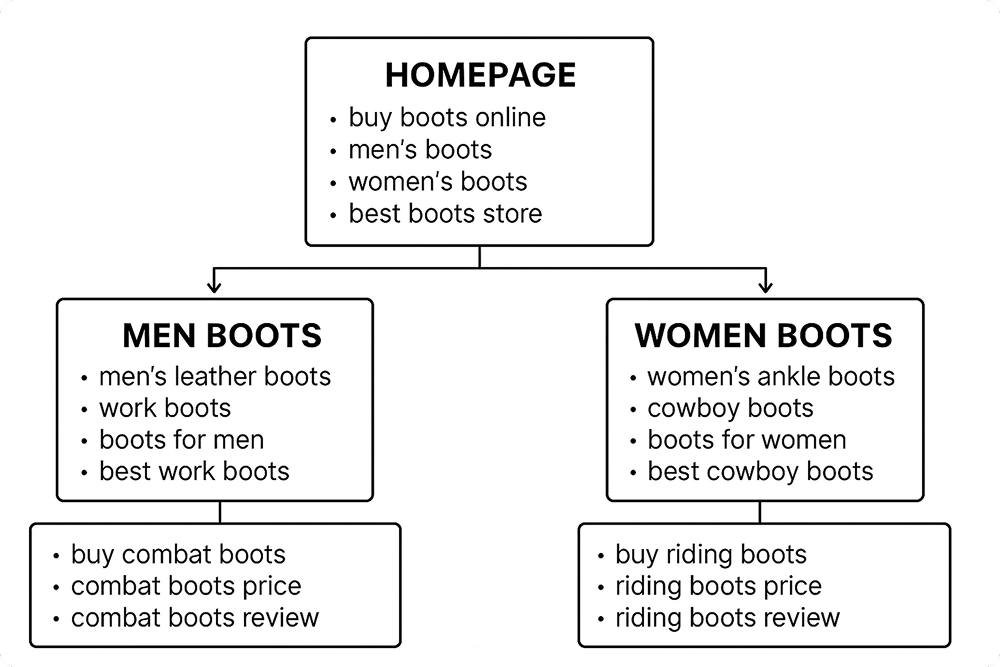
But before you can see the real benefits, you need a solid understanding of your industry. This knowledge helps you sort your keywords into accurate categories and subcategories, which leads to a more organized and effective site structure.
How To Do SEO Keyword Mapping From A to Z
To make the SEO keyword mapping process easier and more structured, below is a step-by-step guide you can follow.
Step 1: Do Your Keyword Research
Keyword research is the very first step of organizing and assigning your target keywords to specific pages. You need to first identify all the relevant and ranking keywords for your specific industry to be able to map them accordingly.
There are different methods you can practise for doing keyword research easily. And there are different SEO tools that can help you, too. One of such tools is Ahrefs, which can help you see ranking keywords, their search intent and important keyword metrics.
Let’s take the example of an online store for boots and see the keyword research steps on Ahrefs:
- Go to the Ahrefs Keyword Explorer tool․
- Type in some main product keywords related to your industry.
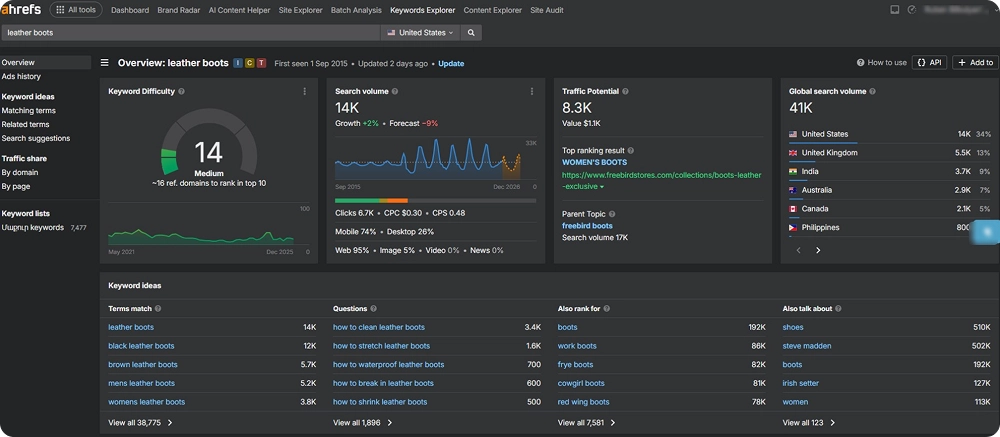
Now you can review the list of ranking keywords along with the metrics Ahrefs provides.
Tip:
- The keywords in the “Terms match” and “Also rank for” sections are useful for building keyword categories and subcategories.
- The keywords in the “Questions” section are great for planning blog posts or other informational content.
You can access all the essential keyword data needed to craft a successful SEO strategy, including keyword difficulty, search volume, and search intent.
For easier analysis, you may also download the results into a spreadsheet.
Step 2: Search Intent Identification
Search intent shows the reason why people search for a specific term, keyword or question. It answers the question of “What do people want” when they type in their search queries.
There are 4 common grouped intents:
- Informational: Users are looking for information, answers, or insights about a topic. Examples include blog posts, how-to guides, and tutorials.
- Navigational: Users want to land on a specific website or page. Examples include searches like “Facebook login” or “Nike official site.”
- Commercial: Users are researching products or services with the intention of buying in the near future. Examples include “best smartphones 2025” or “top SEO tools.”
- Transactional: Users are ready to take action, such as making a purchase, signing up, or downloading. Examples include “buy iPhone 15 online” or “subscribe to Netflix.”
Therefore, gaining insights into your keyword search intent will help you better categorize your keywords and also design your content.
And as already mentioned before, SEO tools like Ahrefs can help you with the identification of search intents by applying the right intent letter to each of the ranking keywords (indicated by the letters “I”, “C”, “T”, or “N” next to each keyword).

Step 3: Categorize and Group Your Keywords
Now that you have your keywords and search intents clear, your next step is to categorize them.
In SEO keyword mapping, categorizing your keywords according to topic, search intent, and relevance is a critical step because it determines how each keyword fits into your website’s structure and content strategy. It also helps search engines understand which pages of your website should rank for specific keywords.
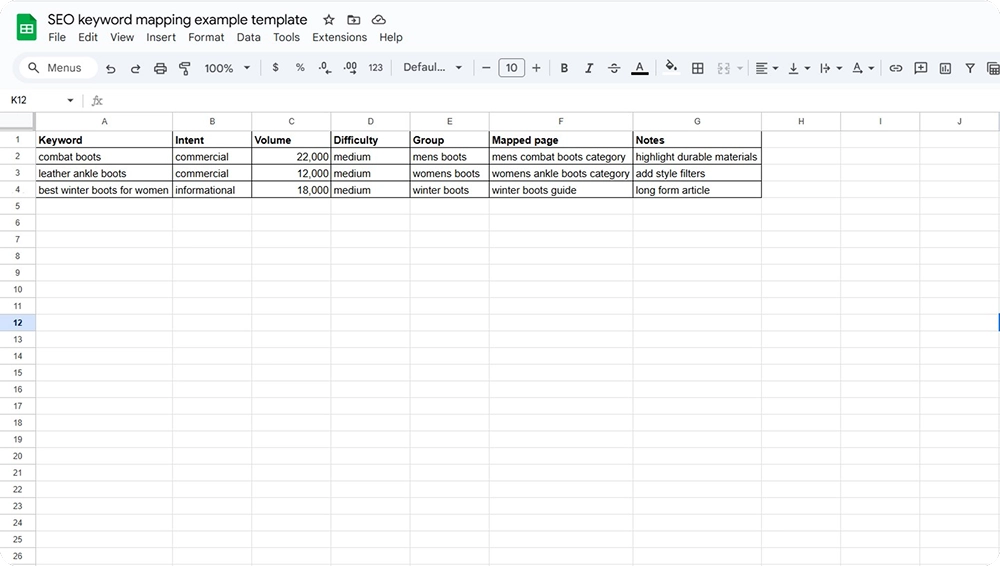
To make this process more organized, consider compiling everything in Google Sheets or Excel. Or you can use specialised SEO tools to help you with grouping and storing your keyword categories.
Here is an example of a layout you can create on these spreadsheets:
Step 4: Assign URLs To Your Pages
Assigning URLs in SEO keyword mapping involves deciding which page on your site will target each keyword group. This turns your research into a clear site structure.
If we again take the example of an online store that sells boots, here are the steps for assigning URLs:
- First, organize your keywords into meaningful topics like men’s boots, women’s boots, leather boots, or winter boots.
- Then match each topic to the most relevant page. This page could be an existing category, a product page, or a new page you plan to create. Each page should focus on one main keyword group. Avoid assigning multiple groups to the same URL.
- Once you determine the right placement, add the chosen URL to your mapping sheet. This gives you a clear blueprint of what every page should target.
Step 5: Regularly Update Your Keyword Map
Keywords, their metrics and SEO realities in general tend to change. Therefore, it is especially important to update your mapped keywords.
Take some time to:
- review the updated keyword metrics,
- identify and categorize new ones
- filter out those that lost their relevance or rankings.
Regular updates ensure your content strategy stays aligned with search behavior and keeps your website competitive.
Conclusion
As you can see, if you want search engines to clearly understand your website’s structure and content, and build a strong content strategy, SEO keyword mapping is essential.
While it can be time-consuming and requires some deep research, the results are well worth the effort.
Follow our guide, learn to use the right tools, and you’ll soon start seeing the results you want.