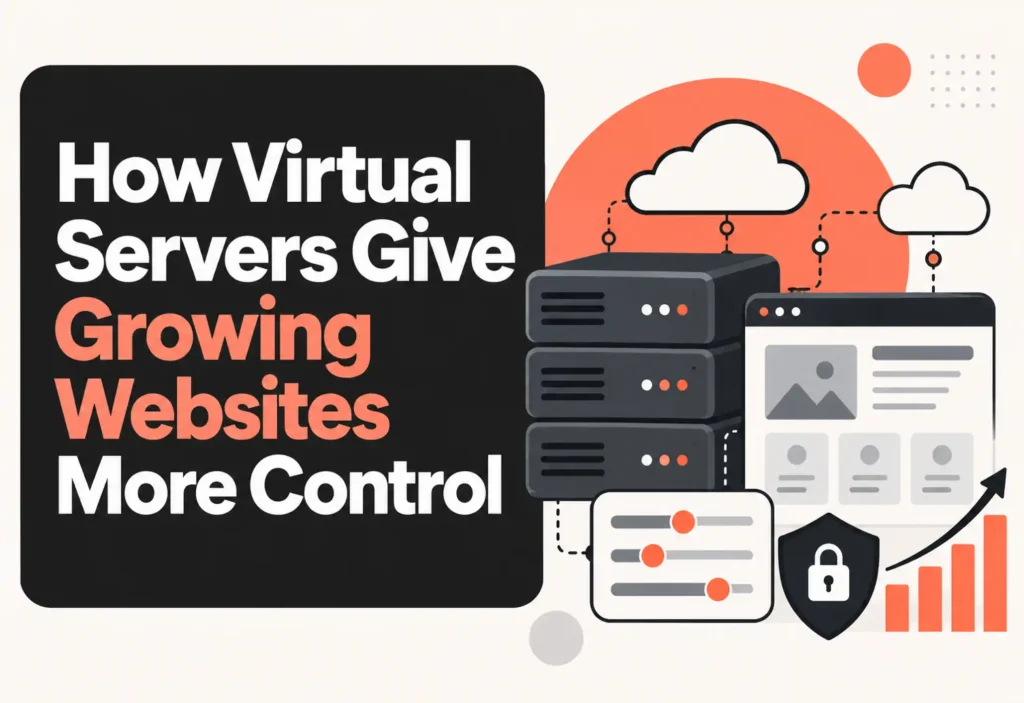
A website can work perfectly well on a simple hosting plan until the business starts asking more from it. Traffic picks up, new features are added, and the site becomes responsible for more of the day-to-day work.
At some point, the issue may not be that the website needs a complete rebuild. It may simply need an environment that gives the team more room to work. That is where a virtual server can become worth considering.
When the Current Setup Starts Feeling Restrictive
There are a few clues that a website has started pushing against the limits of its hosting arrangement. Pages may slow down when traffic gets busy. A new application may require settings that are not available. The technical team may want to install software or make changes that the current environment does not allow.
None of these automatically means it is time to move. First, find out what is causing the limitation. If a poorly optimized image or plugin is responsible for a slowdown, changing servers will not fix it. But if the website repeatedly needs something the current setup cannot provide, the hosting environment deserves another look.
A Virtual Server Creates More Room
A virtual server gives a website its own virtual environment on a physical machine. It is still sharing the underlying hardware, but the setup is more separated than traditional shared hosting. For businesses looking for more control without managing a physical server themselves, VPS hosting can be a practical option. That difference matters when a website needs more control.
Instead of working within the same restrictions as a basic shared environment, the business may have more freedom to configure the server around its website. The exact options depend on the hosting plan, but the general idea is simple: the website gets more room to operate on its own terms.
Control Can Matter More Than Raw Power
It is easy to assume that moving to a more advanced hosting setup is mainly about getting more resources. Sometimes it is about control instead. A development team may need a particular software version. An application might require a specific configuration. A business could need greater freedom over how certain parts of the environment are managed.
Those requirements are difficult to accommodate when the hosting environment is heavily restricted. A virtual server can give the technical team more options without requiring the business to operate its own physical server.
Think About Who Will Manage It
More control sounds appealing until there is a problem and nobody knows how to fix it. A virtual server still needs to be maintained. Someone has to deal with updates, access, security, backups, and troubleshooting. If the business has a technical team that can handle those jobs, that may not be an issue.
For a smaller company, a managed option may make more sense. The hosting provider can take care of some of the technical work, leaving the business with less day-to-day administration. Before choosing a service, find out exactly what the provider handles. “Managed” does not mean the same thing in every hosting package.
Look at What the Website Is Doing Now
The website you have today may be quite different from the one you launched a few years ago. Maybe there are now hundreds of products. Perhaps customers have accounts and log in regularly. A database may have become central to how the site works. Traffic may also be much higher than it was when the original hosting decision was made.
A growing website rarely operates on its own. The business may add staff, software, customer systems, and other online services as it expands, and the IT setup has to keep up with those changes. Look at those changes together. They can tell you whether the website genuinely needs a different environment or whether a few targeted fixes would be enough.
Give the Website More Room to Operate
Virtual servers are useful when a website needs something that a simpler hosting environment cannot comfortably provide. The reason might be greater control, more predictable resources, or the ability to configure the environment around a particular application. It could also be a combination of several smaller limitations that have become difficult to work around.
The important thing is not to upgrade because the business has reached an arbitrary size. Look at what the website is doing, where the current setup is falling short, and what the team actually needs from its hosting environment. When those answers point toward greater control, a virtual server can be a practical next step.